
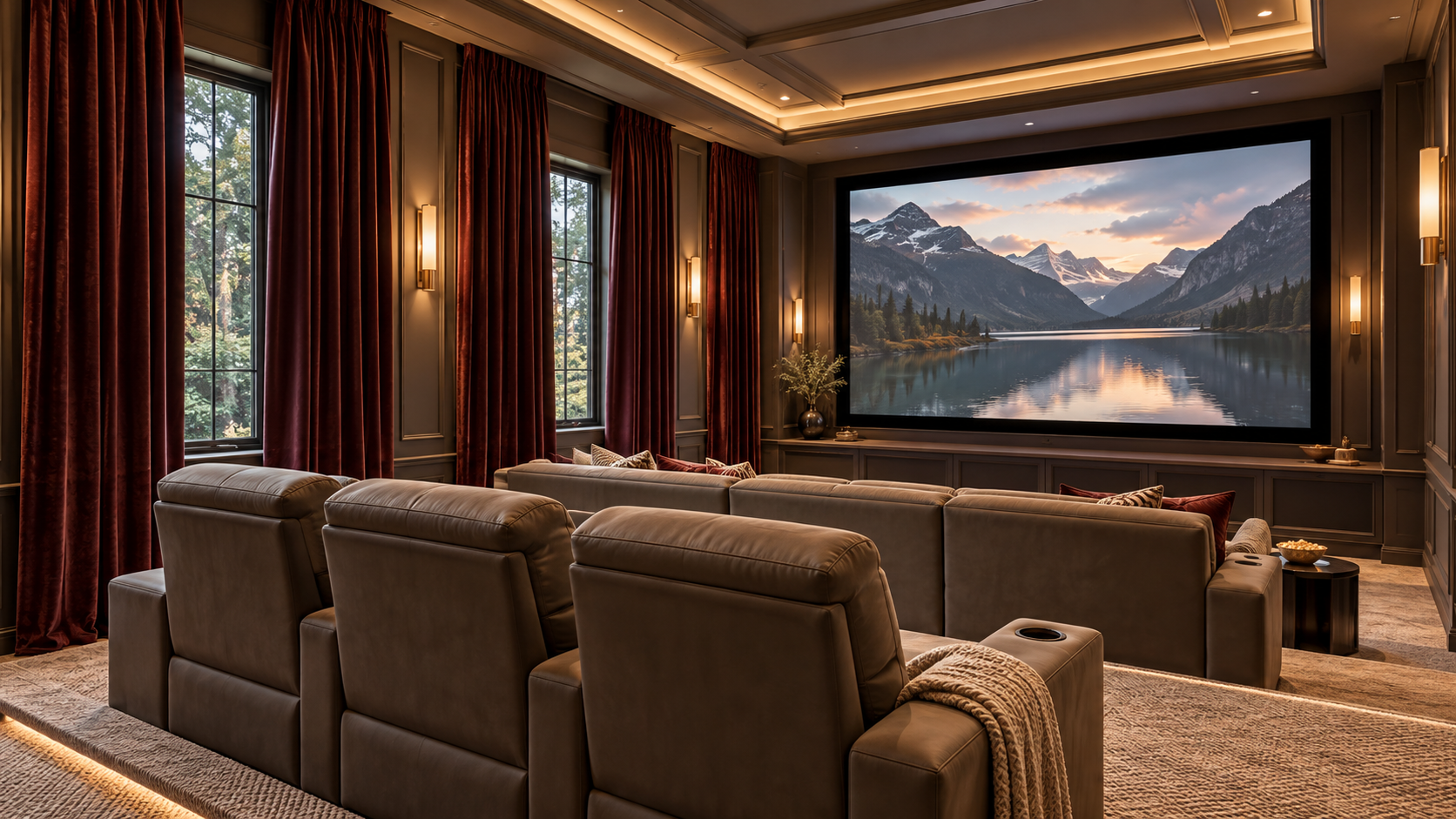
The right curtains can make a surprising difference in a home theater. They can block distracting sunlight, soften the room’s look, and add an elegant finishing touch without major renovations.
But choosing home theater curtains involves more than finding a fabric that matches your décor. The material, lining, length, and installation all affect how well your curtains perform.
Whether you’re designing a dedicated movie theater or updating a family media room, these home theater curtain ideas will help you balance style, light control, and everyday convenience.
This article contains affiliate links. If you make a purchase through one of these links, Home Cinema Living may earn a commission at no additional cost to you.
Quick Guide: Choosing the Right Home Theater Curtains
| What You Want | Best Option |
|---|---|
| Better daytime movie viewing | Blackout curtains |
| A classic cinema appearance | Velvet drapes |
| A modern, streamlined look | Textured curtains with blackout lining |
| Minimal light around window edges | Wraparound rods or ceiling tracks |
| Convenient operation | Motorized curtains |
| A flexible family media room | Decorative curtains paired with blackout shades |
Before buying, consider how much sunlight enters your room, whether you use a projector or television, and how frequently you’ll open and close your curtains.
1. Blackout vs. Room-Darkening Curtains: What’s the Difference?
Blackout and room-darkening curtains may look similar, but they don’t necessarily provide the same level of light control.
Blackout curtains use opaque fabric or a specialized lining designed to block light from passing through. They’re especially useful in projector-based home theaters, where sunlight can wash out the picture.
Room-darkening curtains reduce incoming light without necessarily blocking it completely. They can work well in family media rooms where you want less glare but don’t need total darkness.
The difference matters when shopping online. Some curtains advertised as blackout still let light in around the edges, even when the fabric is opaque.
For a dedicated theater, prioritize clearly specified blackout construction. For an everyday television room, room-darkening curtains may be enough.
Helpful tip: When shopping for blackout curtains online, look for customer photos showing the curtains closed during daylight. These can give you a better idea of how effectively the fabric blocks light.
2. The Best Curtain Fabrics for Home Theaters
Fabric affects both your curtains’ appearance and functionality. Here are four options worth considering.
Velvet Curtains
Velvet brings softness, texture, and traditional cinema character to a home theater. Its substantial appearance complements dark walls and theater-style seating.
However, velvet isn’t automatically blackout. If light control is important, choose velvet curtains with an appropriate blackout lining.
Polyester Blackout Curtains
Polyester curtains are available in many colors, finishes, and price ranges.
Many feature blackout construction, making them practical for everyday movie rooms. They’re also generally easy to maintain, which is helpful in busy family spaces.
Textured Curtains
Woven or linen-look curtains can make a modern media room feel more welcoming without introducing excessive decoration.
For projector rooms, choose textured curtains with blackout backing rather than relying on an open-weave fabric.
Blackout-Lined Decorative Curtains
If you’ve found a beautiful fabric that doesn’t block enough light, a compatible blackout lining may be the solution.
This lets you prioritize appearance while improving light control.
Helpful Amazon Finds
- Velvet Blackout Curtains – Add classic theater character while helping control unwanted daylight.
- Textured Blackout Curtain Panels – Bring a softer, contemporary appearance to a modern movie room.
- Blackout Curtain Liners – Improve light blocking without replacing decorative curtains you already love.
3. Six Beautiful Home Theater Curtain Styles
Once you’ve chosen your fabric, consider how the curtains will fit into your room’s overall design.
Classic Velvet Drapes
Deep burgundy, navy, and charcoal velvet curtains create a traditional cinema atmosphere. Floor-length panels with generous folds provide an elegant finish.
Modern Floor-to-Ceiling Curtains
Ceiling-mounted curtains create clean vertical lines and make a room feel more polished. Warm gray, taupe, and muted neutral fabrics work particularly well.
Minimalist Blackout Panels
Simple, matte blackout panels work best when you want curtains to blend into the surrounding walls rather than become a decorative feature.
Decorative Screen-Framing Curtains
Curtains positioned beside a movie screen can create a private-cinema appearance. Keep the gathered fabric completely clear of the picture, speakers, and equipment ventilation.
Layered Curtains and Shades
Pair decorative curtains with blackout roller shades for flexible daytime viewing. The shade handles most of the light control while the curtains complete the design.
Motorized Theater Drapes
Motorized curtains offer convenient operation, particularly in dedicated home theaters with large windows or compatible smart-home controls.
If you enjoy traditional cinema styling, explore our vintage cinema style ideas for additional design inspiration.
4. Curtains for Projector Rooms vs. TV Rooms
Not every home theater requires the same level of darkness.
Projectors are especially sensitive to ambient light. Sunlight entering through an uncovered window can reduce perceived contrast and make darker scenes harder to appreciate.
For projector rooms, blackout curtains with careful edge coverage are usually the better choice.
Television rooms offer more flexibility, although direct sunlight and reflections can still affect viewing comfort.
A family media room might benefit from decorative room-darkening curtains, while a dedicated projection room may require blackout curtains combined with shades.
Curtain placement matters too. Dark, matte fabrics near a projection screen are generally less distracting than glossy materials that reflect light.
For help deciding which display works best in your space, read our TV vs. Projector for Home Theater guide.
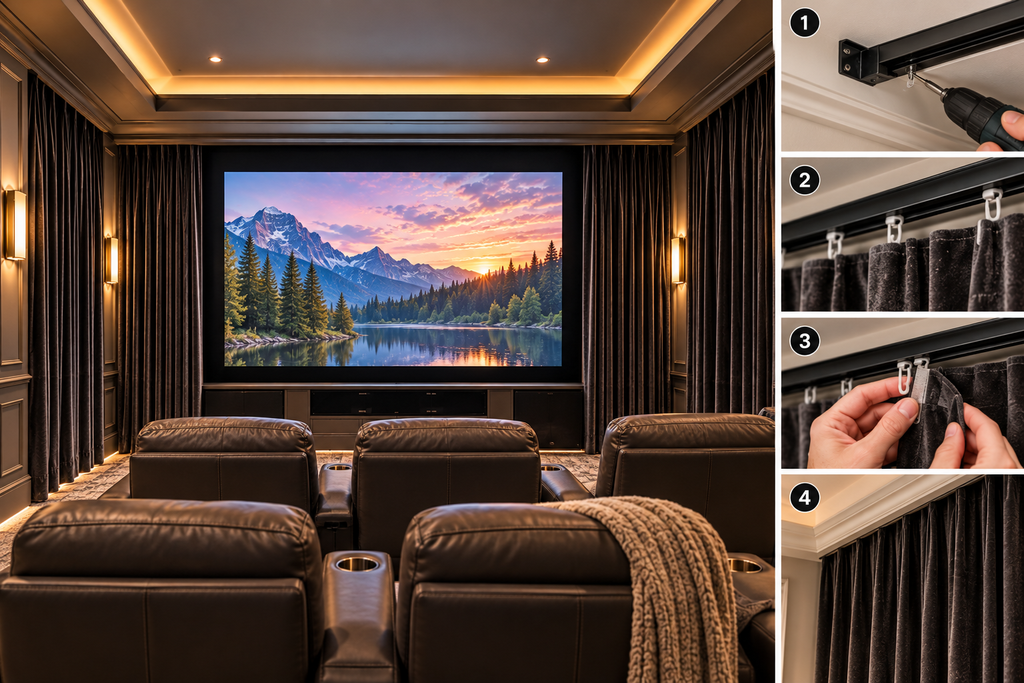
5. How to Prevent Light From Leaking Around Curtains
Even excellent blackout fabric won’t completely darken a room if sunlight enters around the edges.
Light commonly escapes above the curtain rod, along the sides of a window, or between panels.
Fortunately, a few installation details can make a noticeable difference.
Extend the curtain rod beyond the window. Position the rod about 6–12 inches beyond each side of the frame, where space allows, to let the curtains cover the opening more completely.
Mount the curtains higher: Position the rod approximately 4–6 inches above the window frame, where space allows, to help minimize gaps at the top.
Allow the panels to overlap. Curtains that barely meet in the center may leave a bright vertical gap.
Consider wraparound curtain rods. These curve toward the wall, helping reduce openings where daylight can escape.
Use additional shades when necessary. Blackout roller shades, especially those with good side coverage, can add another layer of light control.
For rooms where near-total darkness matters, careful installation can matter as much as the curtain fabric itself.
6. Curtain Rods vs. Ceiling Tracks: Which Is Better?
The hardware you choose affects how your curtains look and operate.
| Hardware | Advantages | Best For |
|---|---|---|
| Standard curtain rod | Affordable, easy to install | Traditional media rooms |
| Wraparound rod | Helps reduce side light gaps | Blackout curtains |
| Ceiling-mounted track | Clean appearance, smooth movement | Floor-to-ceiling drapes |
| Motorized track | Remote or automated operation | Luxury home theaters |
Standard rods are often the simplest choice for existing windows.
Ceiling tracks work well when you want long curtains that create a continuous architectural look.
For heavy velvet curtains, always check the hardware’s weight capacity and mounting requirements.
If you’re renovating, plan curtain tracks before finishing the ceiling for a seamless result.
Helpful Amazon Finds
- Wraparound Blackout Curtain Rods – Help minimize daylight entering along the sides of window treatments.
- Ceiling-Mounted Curtain Tracks – Create a neat, floor-to-ceiling appearance.
- Heavy-Duty Curtain Rod Brackets – Support heavy curtain panels when installed correctly.
7. How to Measure Home Theater Curtains Correctly
Accurate measurements help curtains look better and perform as intended.
Start by measuring the width of your window frame.
Next, decide how far beyond the frame your rod or track will extend. Blackout curtains generally benefit from extra coverage on both sides.
Measure the complete rod or track span rather than purchasing panels based only on the window width.
For a gathered appearance, many standard curtain styles use a combined flat fabric width of approximately 1.5–2 times the rod width.
For example, if your curtain rod spans 80 inches, a combined flat panel width of approximately 120–160 inches can provide attractive fullness, depending on the curtain heading.
Pre-pleated curtains may require different measurements, so always follow the manufacturer’s guidance.
Allow extra fabric for center overlap and side returns where needed.
For curtain length, measure from the appropriate hanging point to the desired finished position.
Floor-length curtains generally create the most polished theater appearance, but they shouldn’t interfere with doors, walkways, or equipment.
Before ordering: Check whether the manufacturer measures curtain length from the top of the fabric, hanging hooks, or another reference point.
8. Are Motorized Curtains Worth It?
Motorized curtains can make preparing your theater for movie night easier.
Instead of manually closing several large panels, you can operate compatible curtains using a remote, smartphone, or smart-home system.
Some systems can also be included in automated routines alongside your theater lighting.
However, motorized curtains aren’t necessary for every home theater.
They’re most useful for large windows, heavy drapes, hard-to-reach installations, or rooms where convenience matters most.
Before purchasing, confirm the curtain weight limit, track dimensions, power requirements, and compatibility with your existing devices.
A well-installed manual curtain can look just as beautiful, so consider automation an optional upgrade rather than an essential feature.
Helpful Amazon Finds
- Motorized Curtain Track Systems – Make opening and closing theater curtains more convenient.
- Smart Curtain Motors – Add automated operation to compatible curtain rods or tracks.
9. Choosing the Right Curtain Color
Curtain color should complement your home theater without creating unwanted reflections.
| Curtain Color | Overall Style |
|---|---|
| Burgundy | Traditional cinema |
| Midnight blue | Elegant and sophisticated |
| Charcoal | Contemporary and understated |
| Forest green | Warm and distinctive |
| Taupe | Relaxed modern media room |
| Black | Minimalist dedicated theater |
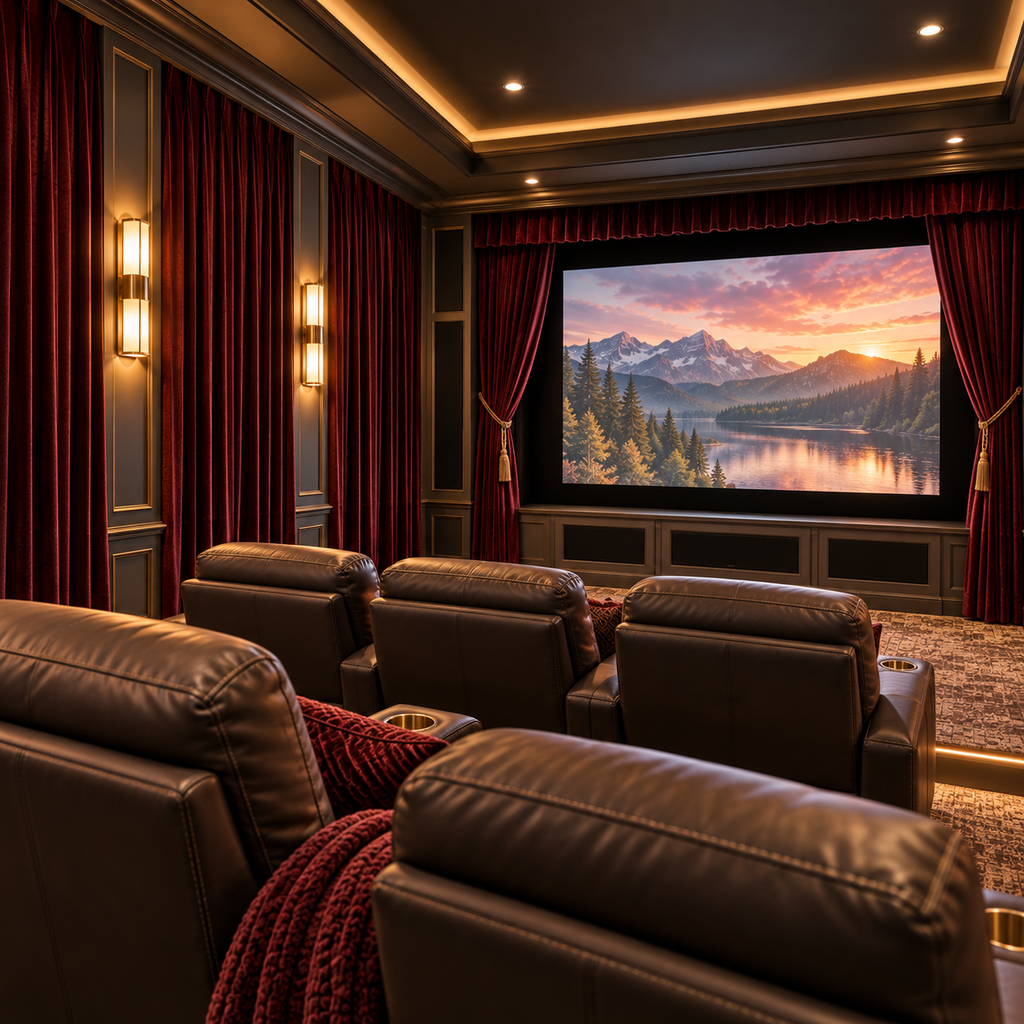
In projector rooms, darker matte fabrics near the screen often work best.
For family media rooms, warmer neutral curtains can create a comfortable appearance while blackout lining handles light control.
If you’re deciding between shades, compare fabric samples in your room under both daylight and movie-night lighting.
Our home theater paint color guide can help you coordinate the surrounding walls.
10. Common Home Theater Curtain Mistakes
A few common mistakes can make otherwise beautiful curtains disappointing.
Buying panels that are too narrow: Curtains need enough width to close properly and cover the opening.
Assuming every dark curtain is blackout: Fabric color alone doesn’t guarantee light blocking.
Ignoring installation gaps: Sunlight can still enter above and around blackout curtains.
Choosing unsupported hardware: Heavy drapes require appropriately rated rods, tracks, and mounting hardware.
Using reflective fabric near the screen: Glossy fabrics can reflect light from the screen, creating unwanted distractions during movies.
Expecting curtains to soundproof the room: Heavy curtains may help reduce echoes and sound reflections, but they won’t prevent sound from traveling between rooms.
For more ways to manage noise, explore our Soundproofing Techniques for a Home Theater guide. You can also read Acoustic Panels vs. Soundproofing to understand the difference between improving sound inside your theater and reducing noise transfer.
Frequently Asked Questions
What curtains are best for a home theater?
Blackout-lined curtains are generally the most practical option for rooms where controlling sunlight is important. Velvet and textured fabrics are attractive choices when paired with appropriate lining.
Do home theater curtains need to be black?
No. Navy, charcoal, burgundy, forest green, and warm neutral shades can all work. Light control depends more on fabric construction and installation than color alone.
Should home theater curtains reach the floor?
Floor-length curtains usually look polished and help avoid gaps beneath the panels. Choose a length that remains practical for your room.
Can curtains go around a projector screen?
Yes. Decorative curtains can frame a screen, as long as the fabric doesn’t block the picture, speakers, ventilation, or other equipment.
Are expensive curtains necessary?
Not necessarily. Affordable blackout panels can work well when sized and installed properly. Prioritize effective coverage and suitable materials before decorative extras.
Final Thoughts
Choosing home theater curtains means balancing appearance, light control, and functionality.
A traditional theater may look beautiful with velvet drapes, while a contemporary media room might benefit from understated blackout panels or elegant floor-to-ceiling curtains.
Whatever style you prefer, pay attention to fabric quality, measurements, and installation. These practical details often make the greatest difference.
With the right curtains, your home theater can feel more comfortable, beautifully finished, and ready for movie night.
Related Articles
- TV vs. Projector for Home Theater
- How to Layer Lighting in a Home Theater
- Home Theater Paint Colors
- Acoustic Panels vs. Soundproofing

Lisa is the creator of Home Cinema Living. Together with her husband, a longtime home theater professional, she has spent years designing and enjoying home theater spaces that bring family and friends together for memorable movie nights.