
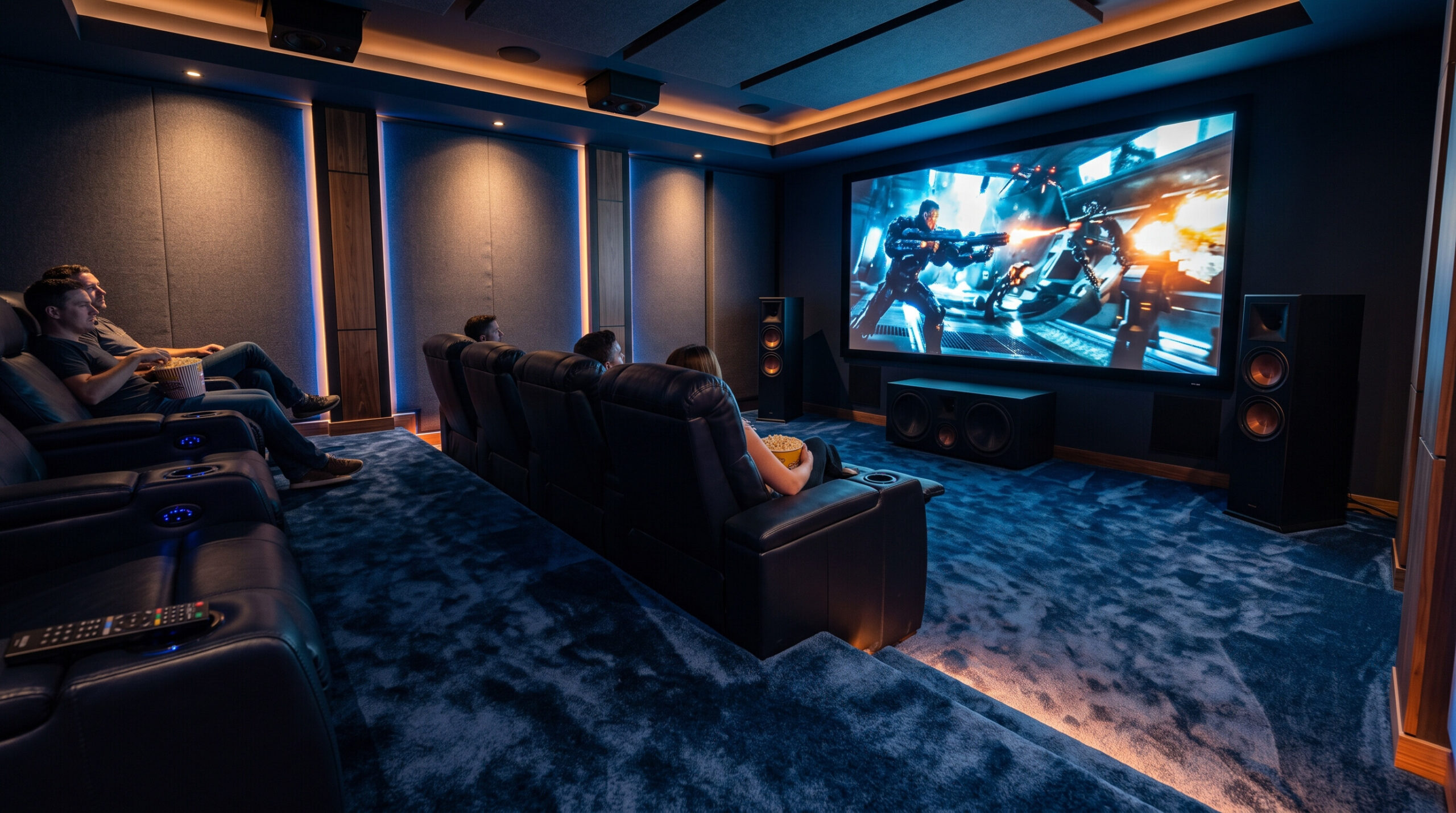
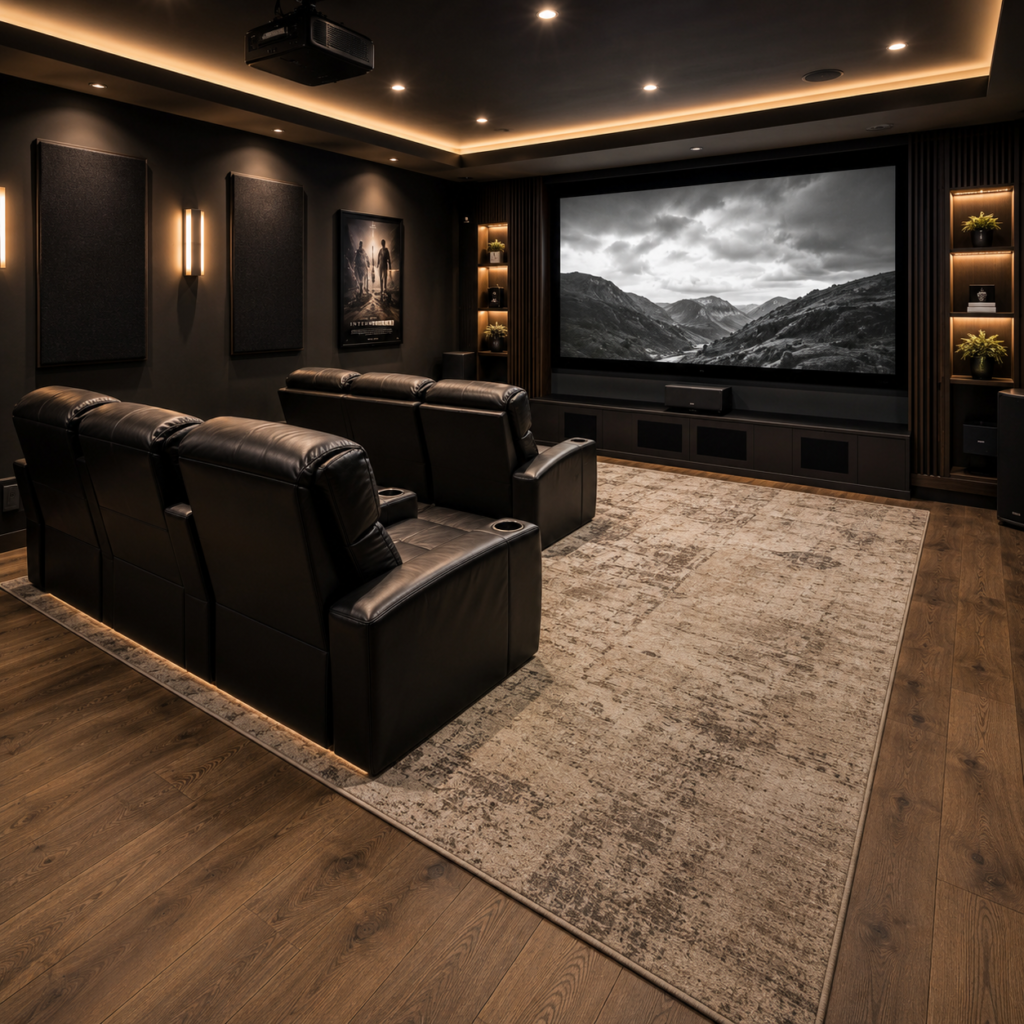
If you want great sound in your home theater, your floors matter more than you might think. Flooring does not just change the look of the room. It also affects acoustics, sound clarity, comfort, and the amount of sound that bounces around the space.
Some flooring materials absorb sound, while others reflect it. Carpet and rugs can help reduce echo and make dialogue clearer. Hard surfaces like tile, hardwood, and laminate can look beautiful, but they usually need extra soft materials to keep the room from sounding harsh.
This guide will help you choose the best flooring for home theater sound, whether you are designing a dedicated theater room, upgrading a basement, or improving a living room media space.
Affiliate disclosure: This post may contain affiliate links. As an Amazon Associate, I earn from qualifying purchases at no extra cost to you.
Quick Guide to the Best Flooring for Home Theater Sound
Here is a simple way to choose the best flooring option based on your room:
| Flooring Option | Best For |
|---|---|
| Plush carpet | Dedicated home theaters and better sound absorption |
| Large area rug | Living room theaters, renters, and hard floors |
| Thick rug pad | Extra comfort, absorption, and vibration control |
| Luxury vinyl plank | Easy cleaning with better softness than tile or hardwood |
| Cork underlayment | Reducing vibration under vinyl, laminate, or wood |
| Hardwood or laminate | Stylish rooms that also use rugs, curtains, and soft furniture |
| Tile | Easy cleaning, but needs rugs and soft decor for better sound |
| Acoustic underlayment | Multi-level homes, basements, and sound transfer concerns |
Why Does Home Theater Flooring Matter for Sound?
The main reason flooring matters is that sound does not only come from your speakers. It also bounces around the room.
Your floor can help control how much sound is absorbed or reflected. Hardwood, laminate, and tile tend to reflect sound. Carpet, rugs, and thick padding help absorb sound and reduce echo.
Getting this balance right can make dialogue clearer, reduce muddiness, and make your home theater feel more immersive. If the room has too many hard surfaces, sound can feel sharp or harsh. If the room has enough softness, the audio usually feels warmer and easier to listen to.
The best home theater flooring setup finds the sweet spot: enough absorption for clear sound, but not so much that the room feels dull or lifeless.
For a deeper look at echo and room treatment, see my guide to Acoustic Panels vs. Soundproofing for Home Theaters.
Common Home Theater Flooring Options and Their Impact on Sound
Different flooring materials affect how your theater sounds. Some absorb sound, some reflect it, and some work best when paired with rugs, padding, or underlayment.
Carpet
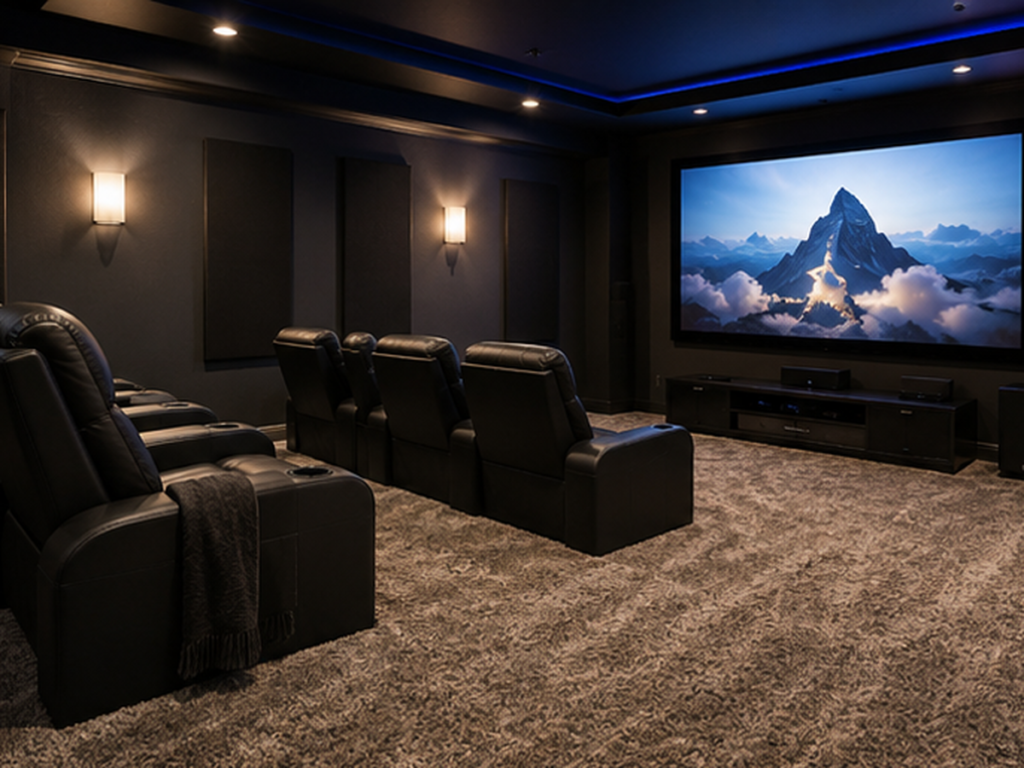
Carpet is one of the best flooring choices for a dedicated home theater. Thick carpet helps absorb sound, reduce unwanted echoes, and make dialogue feel clearer.
It also adds comfort, warmth, and that cozy theater-room feeling. If you are building a room mainly for movies, carpet with a quality pad is usually one of the strongest choices.
The more plush and textured the carpet, the more it can help soften the room. This is especially helpful if your theater has bare walls, a large screen, or powerful speakers.
Rugs
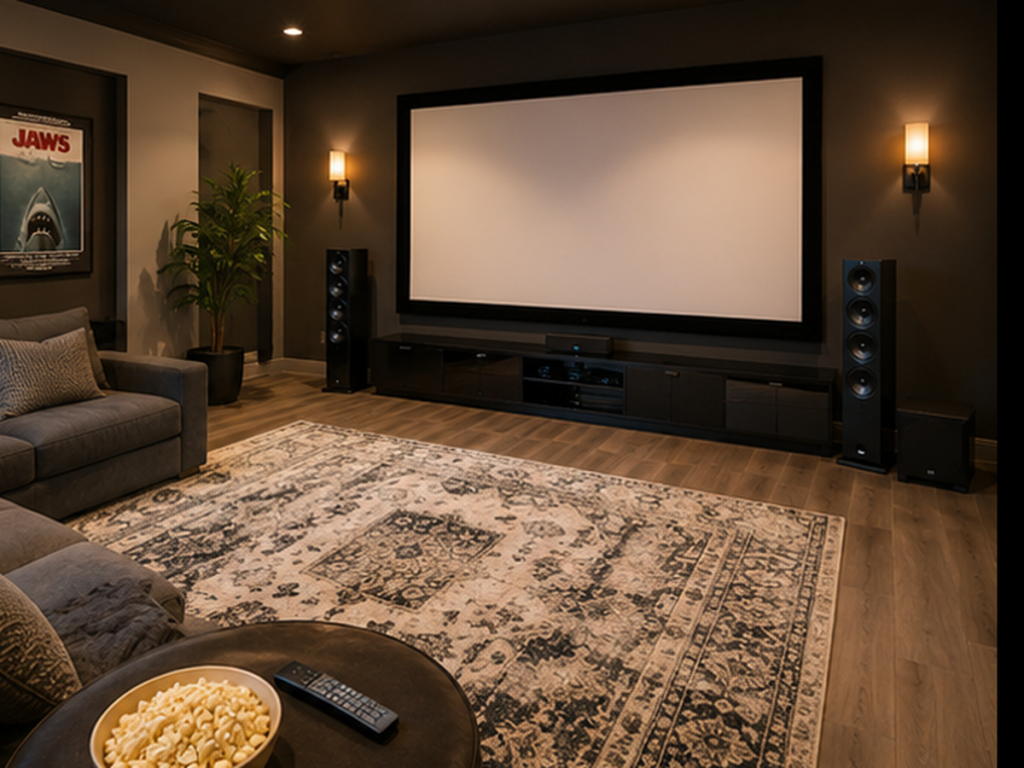
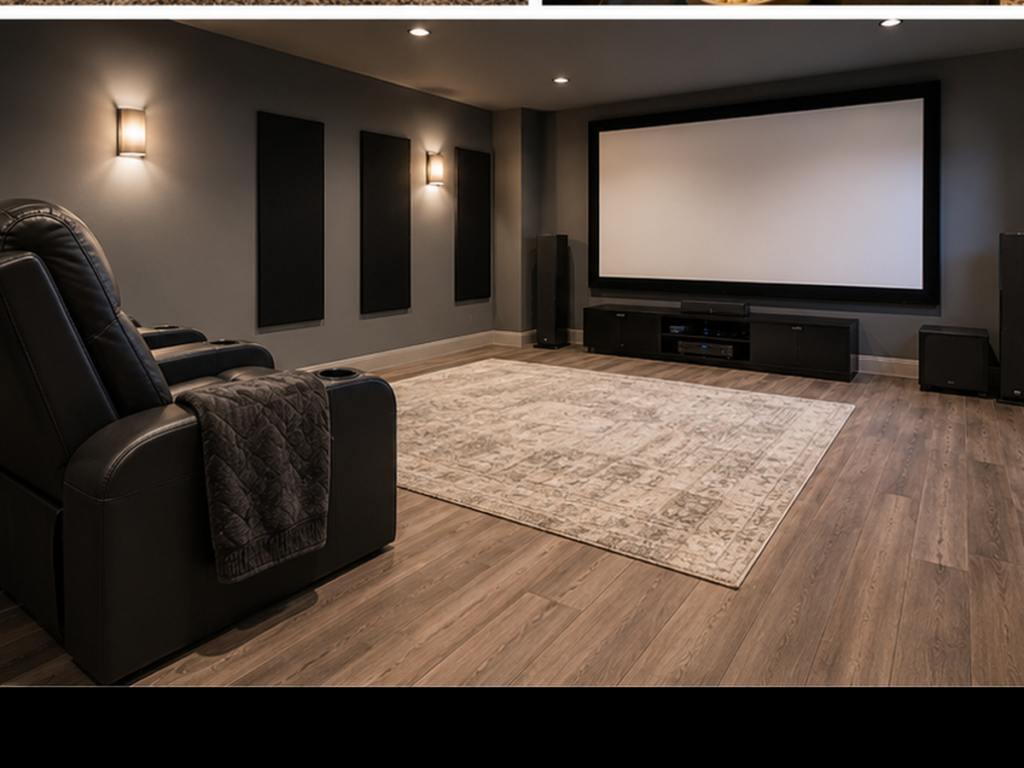
Area rugs are one of the easiest ways to improve sound in a room with hardwood, tile, laminate, or vinyl floors.
A large rug can reduce echo, soften footstep noise, and make the room feel more comfortable. Rugs are also a good choice for renters or anyone who does not want to install wall-to-wall carpet.
The bigger and thicker the rug, the more helpful it will be. For the best results, pair a large area rug with a dense rug pad underneath.
Helpful Amazon searches for home theater rugs
Large rugs are one of the easiest ways to improve sound in a room with hardwood, tile, laminate, or vinyl flooring. A thick rug can help reduce echo while also making the space feel more finished.
- Large Area Rug for Living Room — best for softening sound in a living room theater
- Thick Area Rug — best for adding more absorption and comfort underfoot
- Rug Pad for Sound Absorption — best for adding cushion and reducing vibration under a rug
Hardwood and Laminate
Hardwood and laminate floors can look beautiful in a media room, but they reflect sound more than carpet or rugs.
That does not mean you cannot use them. It just means the rest of the room needs more softness. Large rugs, curtains, upholstered seating, acoustic panels, and fabric decor can help balance the reflective surface.
Hardwood and laminate can work especially well in living room theaters where style matters and the room is used for more than movies.
If you are running wires across or around the floor, see my guide to Hidden Cable Management for a Clean Home Theater.
Vinyl
Luxury vinyl plank can be a nice middle ground for a home theater. It is easier to clean than carpet, softer than tile, and can still look polished.
Vinyl is especially useful in basements, family rooms, or spaces where spills are more likely. It will not absorb sound the way carpet does, but it can work well when paired with an acoustic underlayment, large rugs, and soft furniture.
If you want a clean look but do not want the echo of tile or hardwood, vinyl with a good underlayment can be a practical choice.
Tile
Tile is durable and easy to clean, but it is usually not the best choice for home theater sound on its own.
Because tile is hard and reflective, sound can bounce around the room, making dialogue harder to hear. If you already have tile, you can still improve the room by adding a large plush rug, heavy curtains, upholstered seating, and acoustic panels.
Tile can work in a multipurpose room, but it needs extra softness to avoid that sharp, echoey feeling.
Rug vs. Carpet Sound Quality for Home Theaters
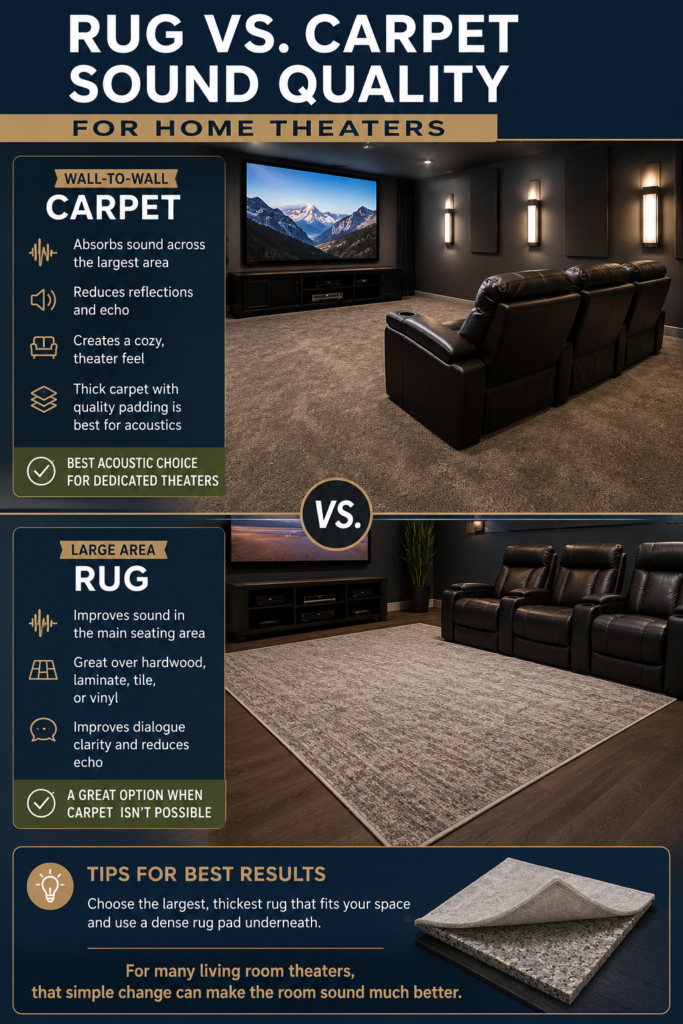
If you are deciding between rugs and carpet, the biggest difference is coverage.
Wall-to-wall carpet absorbs sound across the largest area. It helps reduce reflections, softens the room, and gives the space a cozy theater feel. For a dedicated home theater, thick carpet with quality padding is usually the better acoustic choice.
A large area rug can still make a big difference, especially over hardwood, laminate, tile, or vinyl. It will not cover the entire floor, but it can improve dialogue clarity and reduce echo in the main seating area.
If you cannot install carpet, choose the largest, thickest rug that fits your space and place a dense rug pad underneath. For many living room theaters, that simple change can make the room sound much better.
Important Flooring Factors for Home Theater Sound
There is more to home theater flooring than choosing carpet or wood. The best option depends on how the entire room works together.
Absorption vs. Reflection
Sound absorption and sound reflection both matter.
Too many hard surfaces can make the room sound bright, harsh, or echoey. Too many soft surfaces can make the room feel dull. The goal is balance.
A room with hard flooring may need soft seating, rugs, curtains, and wall panels. A carpeted room may need fewer extra acoustic upgrades.
Underlayment and Padding
The layer under your flooring can make a big difference. Carpet padding, rug pads, cork underlayment, and acoustic underlayment can all help reduce vibration, improve comfort, and limit some sound transfer.
This is especially helpful if your theater is upstairs, above a living space, or near bedrooms.
Helpful Amazon searches for flooring underlayment and padding
The layer under your flooring can make a big difference in comfort, vibration control, and how much sound travels into nearby rooms. For existing rooms, a rug pad is usually the easiest upgrade. For new carpet installation, ask your flooring installer about carpet padding options that provide good sound and comfort.
- Acoustic Flooring Underlayment — best for reducing sound transfer under hard flooring
- Thick Felt Rug Pad — best for adding cushion and absorption under an area rug
- Cork Underlayment — best for adding a sound-dampening layer under hard flooring
Subfloor Material
The material under your main floor can also affect the room.
Concrete floors, which are common in basements, naturally feel more solid and can help reduce some sound transfer. Wood floor joists can transmit more vibration, especially from subwoofers and low-bass frequencies.
If your theater is above another room, dense padding, rugs, acoustic underlayment, and subwoofer isolation can help reduce vibration.
Furniture and Decor
Your flooring is only one part of the sound equation. Big couches, recliners, curtains, ottomans, bookshelves, and acoustic panels all help shape the room’s sound.
For more ways to make the room feel finished and comfortable, see my guide to Home Theater Accessories and Decor.
For seating placement tips, see my guide to How to Choose the Perfect Home Theater Seating Layout.
Optimizing Soundproofing With Flooring Choices
If your theater room shares walls or floors with bedrooms, kids’ rooms, or neighbors, soundproofing becomes more important.
Flooring alone will not completely soundproof a room, but padding and underlayment can help reduce vibration and sound transfer. This is especially helpful for bass, footsteps, and low-frequency rumble.
Acoustic underlayment can be used under vinyl, laminate, hardwood, or carpet. Thick rug pads can also help when you are working with an existing hard floor. In more advanced builds, some people use mass-loaded vinyl, double subfloors, or floating floor systems.
If your main goal is keeping sound from traveling into other rooms, see my guide to Soundproofing Techniques for a Home Theater.
Helpful Amazon searches for flooring soundproofing
If your theater is near bedrooms, upstairs living spaces, or shared walls, flooring upgrades can help reduce vibration and sound transfer.
- Mass Loaded Vinyl Sound Barrier — best for advanced sound isolation projects
- Acoustic Underlayment — best for reducing sound transfer under flooring
- Subwoofer Isolation Pad — best for reducing bass vibration from a subwoofer
Cool Features That Make Certain Flooring Worth Considering
Some flooring choices come with extra features worth considering in a home theater.
Antistatic materials can be helpful in rooms with electronics because they may reduce static buildup. Stain-resistant carpet or rugs are practical for family movie nights with popcorn, drinks, and snacks. Low-VOC flooring can also be a smart choice in rooms with less ventilation.
If your theater is in a basement, look for materials that better handle moisture, such as luxury vinyl plank, sealed concrete with rugs, or appropriate underlayment.
For most families, the best flooring is not just the one that sounds good. It also needs to be comfortable, easy to clean, and realistic for the room’s use.
Real-World Examples and Experience
The differences in flooring can be easy to hear once you start paying attention.
A fully carpeted theater usually feels cozy and focused. Dialogue often sounds clearer, and echoes are less noticeable. A room with hardwood or tile can look beautiful, but sound may bounce more unless you add rugs, curtains, and soft furniture.
A large rug with a thick rug pad can make a hard-floor room feel much better without a full renovation. This is one of the easiest upgrades for a living room theater or media room.
The main lesson is that you can improve sound with layers. A large rug, dense rug pad, soft seating, curtains, and a few acoustic panels can make a big difference even if you start with a hard floor.
More Home Theater Sound Ideas
If you are improving the sound in your home theater, these guides can help you build a better room from the floor up:
- Acoustic Panels vs. Soundproofing for Home Theaters
- Soundproofing Techniques for a Home Theater
- Best Soundbars for Home Theaters and Media Rooms
- How to Choose the Perfect Home Theater Seating Layout
- Hidden Cable Management for a Clean Home Theater
FAQ
Will hardwood or laminate ruin home theater sound?
No, hardwood or laminate will not ruin your home theater sound, but they do reflect more sound than carpet or rugs. If you use hard flooring, add a large area rug, thick curtains, upholstered seating, and other soft materials to reduce echo.
Is wall-to-wall carpet the best option for every home theater?
Wall-to-wall carpet is one of the best choices for dedicated home theaters because it absorbs sound across the full floor. However, large rugs with dense rug pads can also work well, especially in living rooms, basements, or multipurpose media rooms.
Does flooring affect bass or subwoofer performance?
Yes, flooring can affect bass and vibration. Bass can travel through floors, especially wood subfloors. Dense rug pads, acoustic underlayment, and subwoofer isolation pads can help reduce vibration and make bass feel more controlled.
Are rubber floors or cork floors good for theaters?
Rubber and cork can both help with sound and vibration control, but they are usually used in different ways. Cork is often used as underlayment beneath hard flooring. Rubber flooring can absorb vibration, but it may not suit every home theater’s style.
Can I make a tile-floored room sound good for movies?
Yes, but you will need to add softness. A tile-floored theater should have a large plush rug, thick rug pad, soft seating, curtains, and possibly acoustic wall panels to reduce reflections.
Final Thoughts
Your home theater floor is not just about looks. It can affect sound quality, dialogue clarity, comfort, and how much noise travels into the rest of the house.
For dedicated home theaters, plush carpet with a quality pad is usually one of the best options. For living room theaters or multipurpose spaces, a large rug with a dense rug pad can make a major difference without a full renovation. Vinyl with acoustic underlayment can also work well if you want something durable and easy to clean.
The best flooring for a home theater is the one that strikes the right balance of comfort, style, absorption, and practicality. Start with the floor, then layer in soft seating, curtains, wall panels, and smart soundproofing upgrades as needed.

Lisa is the creator of Home Cinema Living. Together with her husband, a longtime home theater professional, she has spent years designing and enjoying home theater spaces that bring family and friends together for memorable movie nights.
The subfloor point is underrated! Wood joists carry way more bass than concrete does, and we get that question a lot from people converting a room over a garage into a theater. One thing worth adding: pad density matters just as much as thickness, and most people just grab the cheapest option without realizing it barely does anything for low-end rumble. We walk clients through this all the time when sound’s actually a priority, not just comfort. Solid breakdown overall!
Thanks, Ricky! Great point about pad density. It’s easy to focus on carpet thickness and overlook what’s underneath, especially in rooms over garages where bass transfer can be more noticeable. Thanks for adding your flooring experience to the discussion!