
Affiliate Disclosure: This article contains Amazon shopping links. As an Amazon Associate, I earn from qualifying purchases. If you buy through my qualifying affiliate links, I may receive a small commission at no additional cost to you.
Dial in the volume, and everything sounds fine; then drop the level, and the dialogue turns muddy while the explosions still rattle the windows. Your speakers or receiver might not be the problem. The room itself could be working against you, and that’s why acoustic panels and bass traps often come up in the same conversation, even though they address different acoustic problems. Buy the wrong treatment first, and you could spend money without fixing what’s actually wrong.
Soundproofing and Acoustic Treatment Solve Different Problems
People often confuse soundproofing and acoustic treatment, but they solve different problems.
Soundproofing helps prevent noise from traveling between rooms, while acoustic treatment improves how sound behaves inside your theater.
If you’re concerned about disturbing other rooms or hearing outside noise, my guide to Acoustic Panels vs. Soundproofing for Home Theaters explains the differences in detail.
Here, we’re focusing on what happens inside your home theater. Acoustic panels help control unwanted reflections, while bass traps target troublesome low-frequency resonances. Understanding which problem affects your room is the first step toward choosing the right treatment.
Acoustic Panels vs. Bass Traps: Quick Comparison Chart
| Feature | Acoustic Panels | Bass Traps |
|---|---|---|
| Main purpose | Reduce unwanted reflections | Control low-frequency resonances |
| Best for | Dialogue clarity, flutter echo, sound imaging | Boomy bass, lingering bass notes |
| Common placement | Side walls, ceiling, reflection points | Corners and selected boundaries |
| Typical construction | Fabric-covered acoustic insulation or foam | Thick porous absorbers or specialized tuned designs |
| Thickness | Often 2–4 inches for broadband panels | Typically requires substantial depth for deep-bass absorption |
| Will it soundproof a room? | No | No |
| Best starting point | Obvious reflection problems | Persistent low-frequency problems |
How to Tell If Your Room Has a Bass Problem or a Reflection Problem
These two problems sound different, and once you know what to listen for, you can usually spot some warning signs in a few minutes.
A bass problem shows up as uneven low end from spot to spot. Walk from your couch to a corner of the room during a bass-heavy scene and listen for the sound to swell or disappear depending on where you’re standing. One frequency might boom constantly on certain tracks while others barely register, regardless of what’s happening on screen.
Room modes often cause that unevenness. Low frequencies reflect between room boundaries, creating peaks and dips depending on where you’re sitting.
A reflection problem sounds different. Dialogue gets hard to place or understand, even when it’s loud enough. Voices can take on a slight echo or a boxy quality, almost like the actor is talking inside a tiled bathroom.
Clap your hands once in the middle of the room and listen to the tail. A sharp, ringy slap-back can indicate sound bouncing between hard walls, ceilings, or windows. It’s a useful first check, though it won’t identify every reflection affecting your speakers.
Most dedicated theater rooms have some combination of both problems. Diagnosing first helps you decide which issue deserves attention before you spend money on treatment.
Where to Place Bass Traps for Better Bass
Low-frequency sound waves are long enough that a single wavelength can stretch across much of a room. As these waves reflect between walls, floors, and ceilings, they create room modes that make certain bass frequencies louder or quieter depending on where you’re sitting.
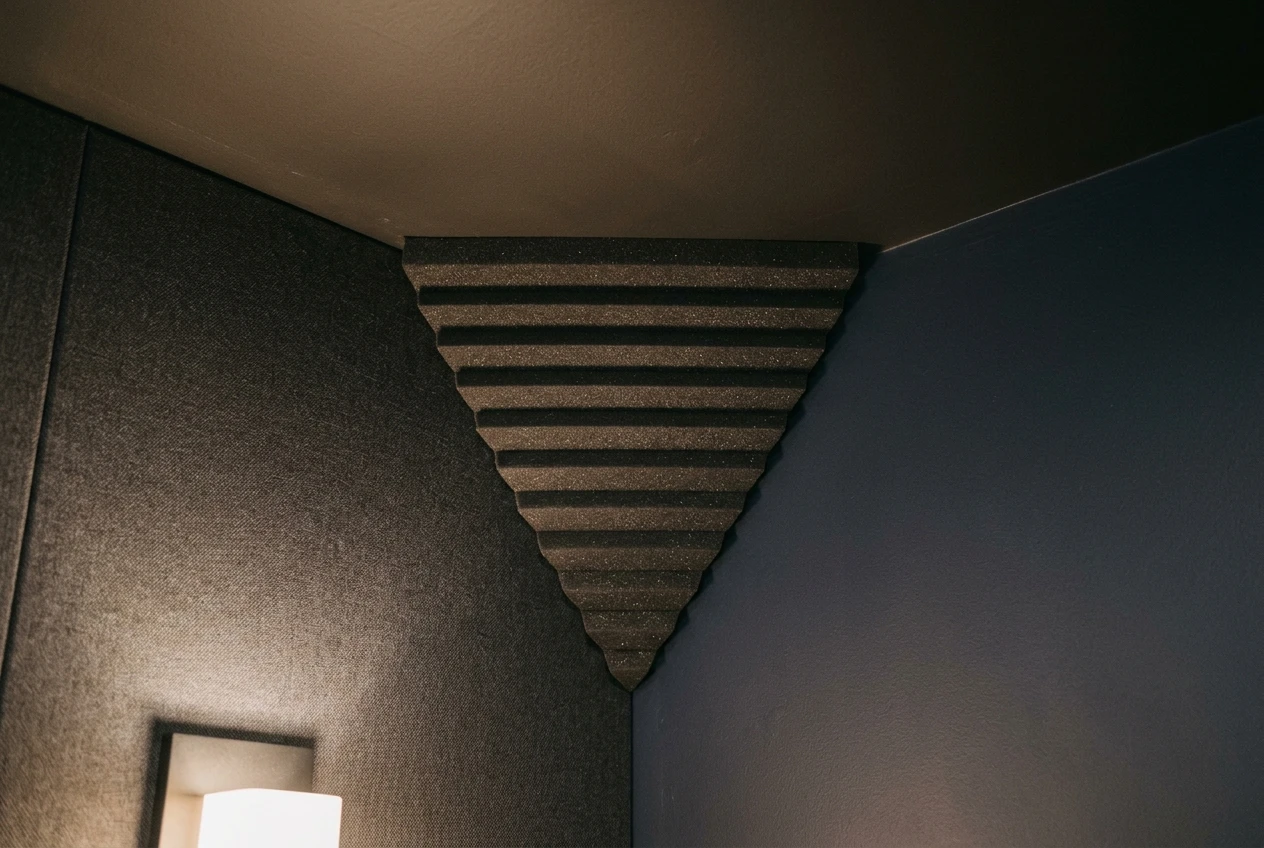
Corners are common locations for bass treatment because multiple room boundaries meet there, and many room modes produce strong pressure variations in these areas. Thick, properly designed bass traps can help control these resonances, making the low end sound more even and less boomy.
This is why bass traps are frequently installed in vertical corners, sometimes extending from floor to ceiling. Thick traps can also work along wall-to-ceiling junctions and other locations selected to address specific room modes.
But before you buy anything labeled a bass trap, you should understand one thing.
Thin foam corner wedges may reduce some higher-frequency reflections, but they generally won’t do much for deep-bass problems. Effective low-frequency treatment usually requires substantial thickness, appropriate materials, or a specialized absorber design.
A small foam wedge and a thick mineral wool bass trap aren’t interchangeable, even if they’re both advertised for the same purpose.
Helpful Amazon Searches: Bass Traps
If you’re comparing options, start with these Amazon searches:
- Thick corner bass traps — Look for substantial depth and coverage for corner placement.
- Mineral wool acoustic bass traps — Worth comparing for broadband absorption.
- Fabric-covered corner bass traps — Useful when you want treatment that blends into your theater design.
Look closely at dimensions, construction, and any published low-frequency absorption measurements. Don’t assume an inexpensive foam package will fix a persistent 50 Hz rumble.
Where Acoustic Panels Actually Change What You Hear
Acoustic panels primarily control reflections in the midrange and higher frequencies, though thicker panels can absorb some lower-frequency energy.
Sound leaves a speaker, hits a hard wall, ceiling, or window, and bounces back into the room slightly delayed from the direct sound reaching your ears.
Strong early reflections can interfere with clarity, making dialogue harder to understand, effects less precise, and the soundstage less defined.
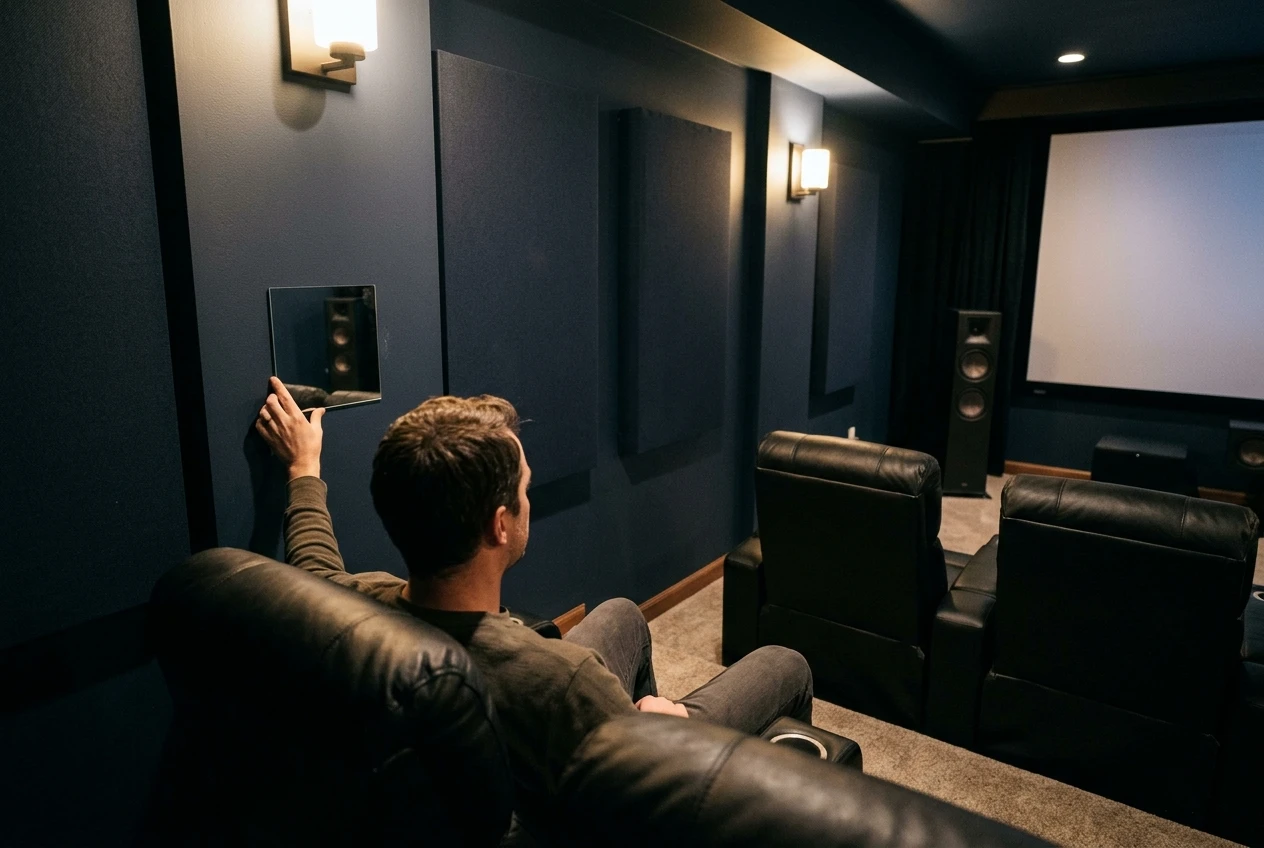
The most useful places to consider are often the first reflection points. These are the spots where sound reflects from a speaker toward your listening position.
You can find side-wall reflection points with a simple mirror test. Sit in your main listening position while someone slides a mirror along the wall at about ear height. Wherever you can see a speaker reflected in the mirror is a potential first reflection point worth treating.
Repeat the process for the opposite wall and consider ceiling reflections if your room has a particularly hard, reflective ceiling.
Panels don’t need to cover every wall edge to edge, and over-treating a room can leave it sounding unnaturally dull, especially if you’ve absorbed the treble while leaving bass problems untouched.
A handful of properly placed panels can do more good than a dozen scattered around without a plan.
For general reflection control, fabric-wrapped broadband panels about 2 to 4 inches thick are often a better starting point than thin decorative foam tiles. An air gap behind a panel can also improve low-frequency absorption.
Helpful Amazon Searches: Acoustic Panels
These Amazon searches cover a few practical options:
- 2-inch fabric-wrapped acoustic panels — A starting point for controlling common reflections.
- 4-inch broadband acoustic panels — Worth considering when you want absorption across a broader frequency range.
- Home theater acoustic wall panels — Useful for comparing colors, sizes, and mounting styles.
Choose panels based on their absorption performance, not just color or appearance. A decorative panel can look impressive but offer little useful treatment.
Reading Your Room’s Shape and Dimensions Before You Buy Anything
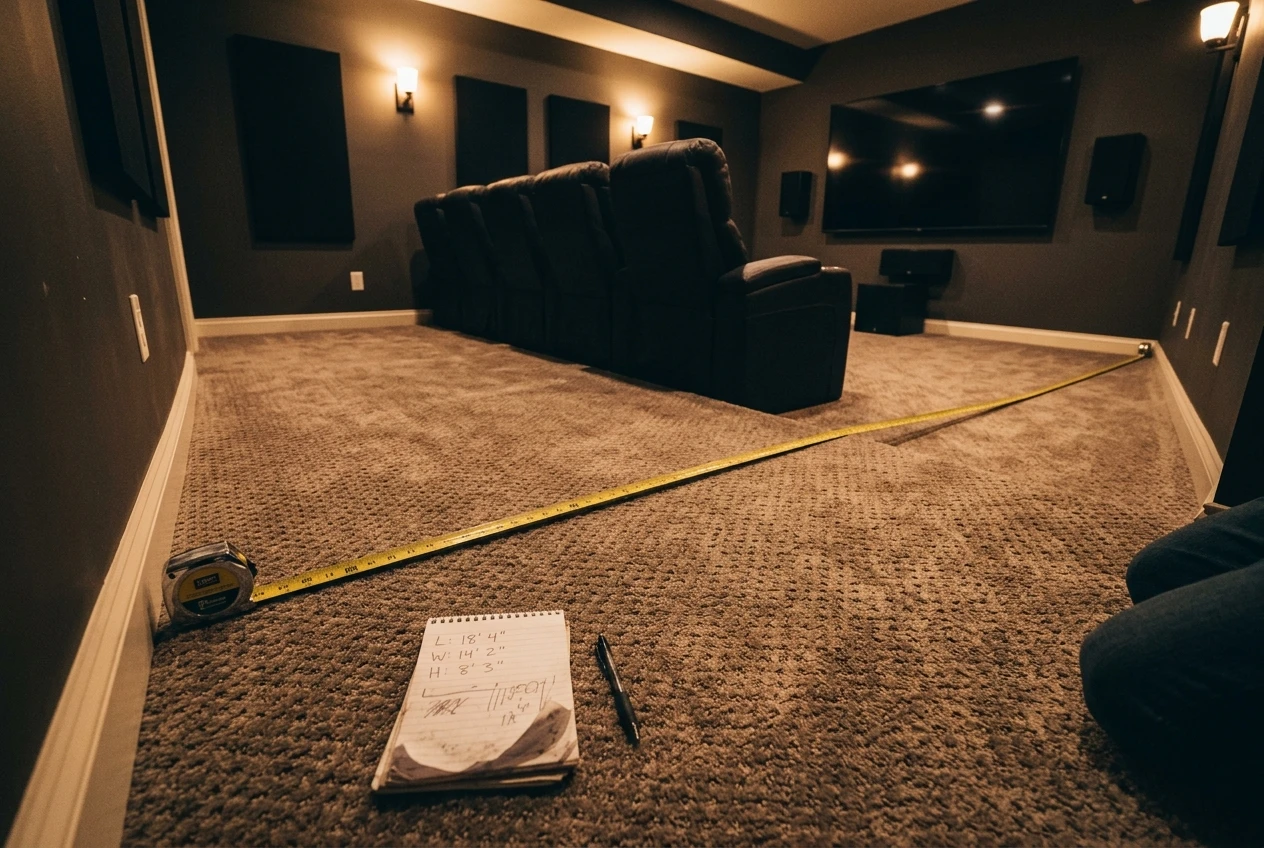
Before ordering anything, take 10 minutes to measure with a tape measure.
Measure the room’s length, width, and height, and write them down.
Rooms where two dimensions are the same, or where one is close to a simple multiple of another, can produce more pronounced bass peaks and dips because several room modes may reinforce similar frequencies.
That doesn’t make the room unusable. It simply means low-frequency behavior deserves closer attention.
Count the corners and note which ones you can treat. A typical rectangular room has four vertical wall-to-wall corners, plus the junctions where walls meet the ceiling and floor. You won’t necessarily need to treat every location, but knowing what’s available makes planning easier.
Rooms with alcoves, sloped ceilings, or openings into adjacent spaces can behave differently from simple rectangular rooms. Those features don’t automatically mean you need more bass traps, but they can make generic treatment kits less predictable.
Note what’s already on your walls, too.
Bare drywall and a large uncovered window reflect sound much harder than many soft furnishings. Heavy curtains, upholstered furniture, and bookshelves can all affect reflections, although they aren’t substitutes for proper bass treatment.
If you’ve already improved your theater’s look with heavier drapery or vintage-style furnishings, you may have reduced some reflections without realizing it.
That changes how much additional treatment you might need.
A Five-Minute Listening Test You Can Run Tonight
You don’t need measurement equipment to get a useful first impression of your room. Two simple tests, run back-to-back, can help you decide where to investigate further.
Test 1: Listen for Uneven Bass
Play a movie or track with sustained low-frequency content, something with a steady rumble rather than short, isolated hits.
Sit in your main listening position and listen for a few seconds. Then stand up and walk slowly around the room, including near the walls and corners.
If the bass noticeably swells near a wall and thins out elsewhere, you’re hearing an uneven low-frequency response. Room modes are a likely contributor.
Before ordering bass traps, consider adjusting the subwoofer or your listening position. Small placement changes can sometimes make a surprisingly noticeable difference.
Test 2: Listen for Reflections
Stand in the middle of the room and clap your hands once, sharply.
Listen to what happens immediately afterward. A ringing or rapid, repeated echo can indicate flutter echo between reflective surfaces.
Acoustic panels can help control these reflections.
Remember, a clap test isn’t a complete acoustic diagnosis. Some reflections that interfere with dialogue clarity won’t produce an obvious echo.
For a more detailed picture, a measurement microphone and free software like Room EQ Wizard can identify frequency-response problems and show whether your changes are working.
Helpful Amazon Searches & Finds: Room Measurement
- Calibrated USB measurement microphones — Useful for measuring room response.
- MiniDSP UMIK-1 measurement microphone — A commonly used option for home theater measurements.
- Microphone stands for acoustic measurements — Useful for keeping measurements consistent.
You don’t need professional measurement equipment to begin, but it’s especially useful for troubleshooting persistent bass problems.
Putting Together a Treatment Plan That Matches Your Room
Once you have a better idea of what’s happening, you can build a plan around your room instead of ordering a generic kit and hoping for the best.
If your bass test revealed strong unevenness, start by reviewing subwoofer placement, listening position, and receiver calibration. Those adjustments may improve the low end before you spend money on acoustic treatment.
If troublesome resonances remain, well-designed bass traps can reduce their severity and decay. Corners are sensible starting points in many rooms, especially when you have space for substantial traps.
If your reflection test revealed obvious ringing or slap-back echo, prioritize panels at the surfaces contributing to those reflections. Side-wall and ceiling reflection points are common places to investigate.
If both tests revealed problems, which is common in untreated home theaters, you’ll likely benefit from a combination of bass traps and broadband acoustic panels.
Which Treatment Should You Prioritize?
| What You’re Hearing | What to Check First | Treatment to Consider |
|---|---|---|
| Bass booms in certain seats | Subwoofer and seating position | Proper low-frequency bass traps |
| Bass notes linger too long | Room modes and bass decay | Bass traps |
| Dialogue sounds smeared or unfocused | Center speaker setup and early reflections | Broadband acoustic panels |
| Sharp echo when clapping | Reflective parallel surfaces | Acoustic panels |
| Bass and dialogue both sound unclear | Placement, calibration, and room reflections | Combination of panels and traps |
| Sound leaks into another room | Doors, gaps, walls, and floor construction | Soundproofing, not acoustic treatment |
Don’t feel obligated to treat the entire room at once. Start with the biggest problem, make a few changes, and listen again.
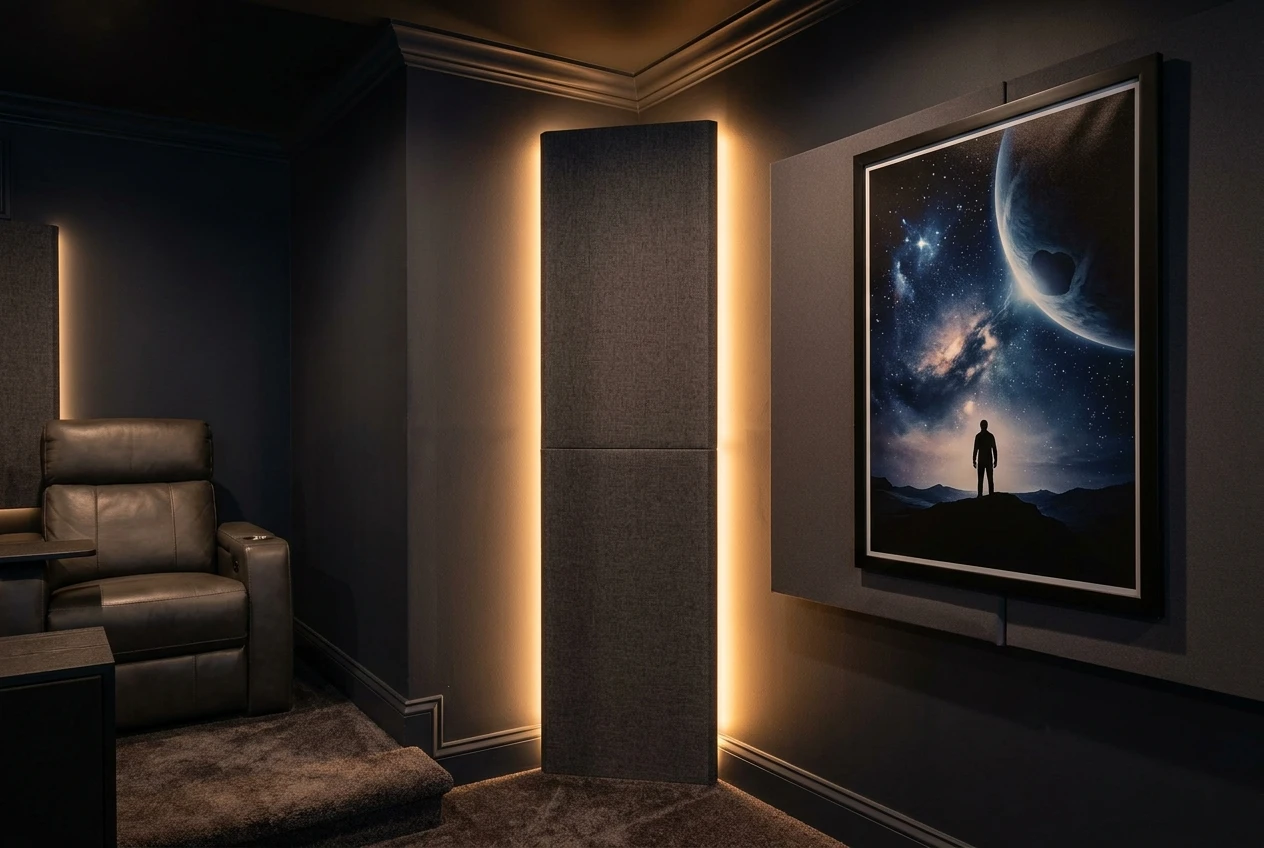
And remember, a room that sounds right doesn’t have to look like a recording studio. Fabric-wrapped panels can blend into your wall colors, and you can incorporate acoustic treatment into decorative frames or movie-poster-style designs, as long as the covering materials don’t interfere with absorption.
Common Mistakes to Avoid When Buying Acoustic Treatment
One of the easiest mistakes is assuming that any product advertised for acoustic treatment will improve every sound problem.
Thin foam tiles can help with some higher-frequency reflections, but they aren’t a substitute for thick broadband panels or proper bass traps. Likewise, installing bass traps won’t automatically correct a poorly positioned center speaker or an improperly configured receiver.
Another common mistake is covering too much wall space before identifying where treatment is needed.
You don’t have to make every surface absorb sound. You want to control the reflections and resonances that interfere with your listening experience while preserving a natural sense of space.
Finally, don’t overlook the setup you already own. Subwoofer placement, crossover settings, speaker positioning, and room correction can all affect what you’re hearing.
Acoustic treatment works best as part of a complete room setup, not as a substitute for proper system configuration.
Frequently Asked Questions About Acoustic Panels and Bass Traps
Do I Need Both Acoustic Panels and Bass Traps?
Many home theaters benefit from both because they address different acoustic problems. However, the amount of each depends on room dimensions, furnishings, speaker placement, and the issues you’re trying to solve. Diagnosing the room first is better than assuming you need a full treatment package.
Can Acoustic Panels Work as Bass Traps?
Thick broadband acoustic panels can absorb some lower-frequency sound, especially when installed with an air gap. But ordinary thin wall panels generally aren’t effective enough to control deep bass resonances. Dedicated bass traps are often better suited to that job.
Are Foam Bass Traps Worth Buying?
It depends on what frequencies you’re trying to control. Thin foam corner wedges may help with some midrange and higher-frequency reflections, but they usually provide limited absorption in the deepest bass range. Check published performance data before buying.
Where Should I Put Acoustic Panels in a Home Theater?
Start with the first reflection points on the side walls and ceiling. The ideal locations depend on your speakers, listening position, and room layout. You don’t need to cover every wall to make a noticeable improvement.
Can Acoustic Panels or Bass Traps Soundproof My Room?
No. Acoustic panels and bass traps primarily control sound within the room. Soundproofing requires construction methods that reduce sound transmission through walls, floors, ceilings, doors, and other openings.
Final Thoughts
Getting better home theater sound isn’t about covering every wall with acoustic foam or filling every corner with bass traps. It’s about understanding how your room affects the sound and making changes that actually address those problems.
If bass booms in one seat and disappears in another, start with subwoofer placement and low-frequency behavior. If dialogue sounds hollow or reflections make effects less precise, acoustic panels may be a better place to start.
And if your room has both problems, you may need a combination of treatments.
Start with what you can hear, make changes gradually, and pay attention to the results before buying more.
A well-treated home theater doesn’t have to look like a recording studio or require an unlimited budget. With thoughtful placement and the right materials, you can create a room that sounds clearer, feels more balanced, and still looks like the comfortable movie-night space you wanted.
Related Articles
Looking for more ways to improve your home theater? These guides can help you get the most out of your space.
- Acoustic Panels vs. Soundproofing for Home Theaters — Learn the difference between controlling sound inside your theater and keeping it from traveling into other rooms.
- Speaker Placement Tips for a Home Theater vs. a Family Living Room — Learn how proper speaker placement can improve dialogue clarity and surround effects.
- Best Flooring for Home Theater Sound — Explore how different flooring materials influence your room’s acoustics.
- Home Theater Accessories and Decor — Discover practical finishing touches to make your theater more comfortable and inviting.

Lisa is the creator of Home Cinema Living. Together with her husband, a longtime home theater professional, she has spent years designing and enjoying home theater spaces that bring family and friends together for memorable movie nights.