
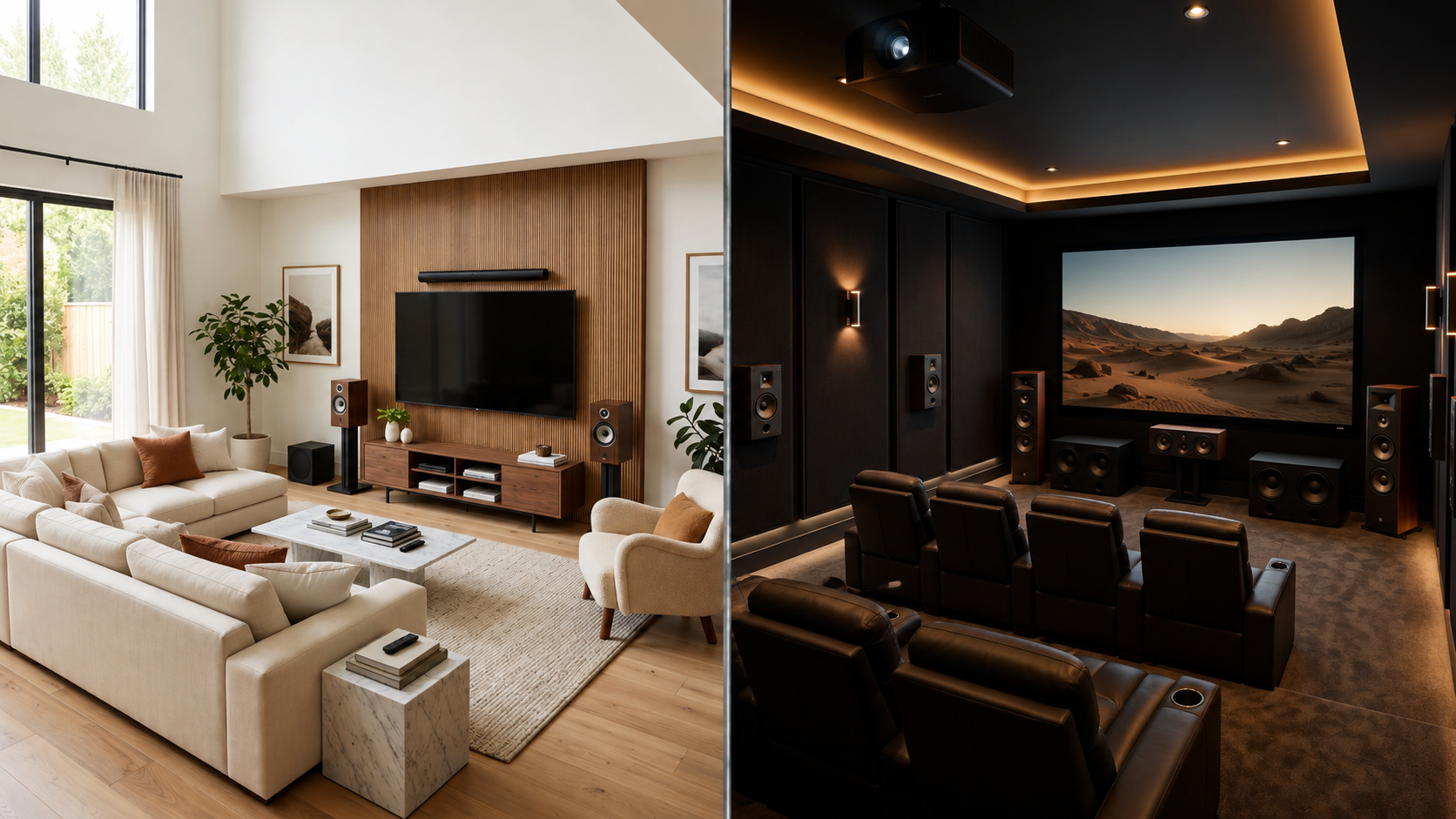
Proper speaker placement can improve your sound more than many expensive equipment upgrades.
When speakers are positioned correctly, dialogue sounds clearer, bass feels more balanced, and effects move naturally around the room. Poor placement can make even a good system sound muddy, harsh, or disconnected from the screen.
The best setup depends on the room. A dedicated home theater usually allows for symmetrical placement, permanent wiring, and carefully planned seating. A family living room often includes windows, walkways, fireplaces, shelves, and furniture that limit where speakers can go.
The goal is not to make the room technically perfect. It is to create a clear, balanced sound without making the space uncomfortable or difficult to use.
Affiliate disclosure: This post may contain affiliate links. As an Amazon Associate, I earn from qualifying purchases at no extra cost to you.
Quick Speaker Placement Guide
| Speaker | Recommended Placement |
|---|---|
| Front left and right | On both sides of the screen, angled toward the main seating area |
| Center channel | Directly above or below the screen |
| Surround speakers | Beside or slightly behind the main seating position |
| Rear surrounds | Behind the seating in a 7.1 system |
| Dolby Atmos speakers | In or near the ceiling, or as upward-firing modules |
| Subwoofer | Near the front wall or wherever testing produces the smoothest bass |
| Soundbar | Centered directly below or above the television |
Why Speaker Placement Matters
Speakers interact with the room around them. Walls, floors, windows, furniture, and ceiling height all influence how sound reaches the listener.
Poor placement may cause unclear dialogue, uneven bass, weak surround effects, harsh reflections, or sound that seems disconnected from the picture.
Before replacing equipment, try repositioning the speakers and recalibrating the system. A small change in height, angle, or distance can sometimes make a noticeable difference.
Speaker Placement in a Dedicated Home Theater
A dedicated theater gives you the most control because the room can be arranged around the screen, speakers, and seating.
Whenever possible, keep matching speakers the same distance from the main listening position and mounted at the same height. Symmetry helps create a more balanced soundstage.
Front Left and Right Speakers
Place the front-left and front-right speakers on either side of the television or projector screen. Keep them evenly spaced from the center of the display and angle them slightly toward the main seats.
Keep the tweeters near seated ear level, leave some space from the walls, and use the same height and angle on both sides. Avoid corners and keep furniture or decorations out of the way.
The speakers should be far enough apart to create a wide soundstage but not so far apart that the center sounds empty.
If you use an acoustically transparent projector screen, the front speakers may be placed behind it. This can make voices and effects appear to come directly from the picture.
Center Channel Speaker
The center channel carries much of the dialogue, so it should be aligned with the center of the screen.
Place it directly above or below the display. If it sits below the screen, angle it upward toward the listeners. If it is mounted above the screen, tilt it downward.
Avoid placing the center speaker deep inside a cabinet or behind decorations. Bring it close to the front edge of the shelf so sound does not reflect inside the furniture.
If dialogue sounds muffled while music and effects remain clear, center-channel placement should be one of the first things you check.
Surround Speakers
In a typical 5.1 system, surround speakers should be placed to the sides of or slightly behind the main seating position.
They should support the action without drawing attention to themselves. If a surround speaker is extremely close to one person’s head, raise it slightly, move it farther away, or reduce its level during calibration.
Keep both surrounds at the same height, at similar distances from the main seats, and clear of tall furniture. Slightly above ear level may help the sound reach several listeners.
Wall-mounted speakers can work well in narrow rooms. Adjustable mounts make it easier to aim the speakers toward the seating area.
Rear Speakers in a 7.1 System
A 7.1 system adds two rear surround speakers behind the audience.
This layout works best when there is space between the seating and the back wall. In a small room, a well-positioned 5.1 system may sound better than seven speakers crowded around the couch.
For help planning the seats around the speakers, see How to Choose the Perfect Home Theater Seating Layout.
Dolby Atmos Speakers
Dolby Atmos adds height effects so sound can appear to move overhead.
Atmos may use in-ceiling, on-ceiling, high wall-mounted, or upward-firing speakers. With two height speakers, place them near the main listening area. A four-speaker system normally uses one pair in front of the seating and another behind it.
Upward-firing speakers need open space above them because they reflect sound from the ceiling. They may be less effective with very high, vaulted, or heavily textured ceilings.
Follow the placement diagram for your exact receiver and speaker configuration.
Subwoofer Placement
The best subwoofer location is not always the most obvious.
Common starting points include:
- Near the front wall
- Beside the media console
- Between a front speaker and the center channel
- Near a front corner
- Along a side wall
Corners can make bass louder, but they can also make it sound boomy. Moving the subwoofer only a foot or two may change the bass throughout the room.
To perform a subwoofer crawl, temporarily place the subwoofer near the main seat, play a steady bass tone, and walk around the room. Move the subwoofer to a location where the bass sounds full but not boomy, then recalibrate the system.
Two subwoofers may improve bass consistency across several seats, especially in a larger theater.
Speaker Placement in a Family Living Room
A family living room often requires compromise.
The television may share a wall with a fireplace, the couch may need to remain against a wall, and walkways cannot be blocked by speaker stands. The room still needs to feel comfortable for everyday use.
Start with the main seating position and create the most balanced layout the room allows.
Work With the Existing Furniture
Perfect symmetry may not be possible, but you can avoid the most common placement problems.
Keep the television and main seating reasonably aligned. Do not block speakers with furniture, place stands in walkways, or leave cords unsecured. Wall mounts and receiver calibration can help when the room is not symmetrical.
A clean 3.1 or 5.1 system may work better than a crowded 7.1 system in a shared room.
For a broader comparison, read Home Theater vs. Living Room: Which Setup Is Better?.
Bookshelf Speakers vs. Tower Speakers
Tower speakers can create a strong front soundstage, but they take up more floor space.
Bookshelf speakers on sturdy stands are often easier to fit into a family room. Stands help bring the tweeters closer to ear level and allow the speakers to be angled toward the seats.
Avoid placing bookshelf speakers directly on the floor, behind decorations, or deep inside a shelf. If they must sit on furniture, move them close to the front edge and leave open space around them.
Soundbars for Smaller Rooms
A soundbar can be a practical choice for a small living room, apartment, or multipurpose media space.
Center it directly below or above the television. Keep the front and top of the soundbar clear, especially if it includes upward-firing Atmos drivers.
A soundbar with a wireless subwoofer adds impact without long speaker-wire runs. Some models also support optional rear speakers.
See Best Soundbars for Home Theaters and Media Rooms for more setup ideas.
Surround Speakers in a Shared Room
Family rooms do not always have open walls in the ideal surround locations.
Compact stands, adjustable wall mounts, in-wall speakers, wireless rear-speaker kits, and soundbar surrounds can all work when ideal wall locations are unavailable.
Remember that wireless rear speakers usually still need electrical power. Check where the nearest outlets are before choosing a system.
Move the Couch Forward When Possible
A couch pushed directly against the back wall can make bass less even and leave little room for surround effects behind the audience.
Leave space between the seats and the rear wall when practical, but do not sacrifice a safe walkway simply to follow a speaker diagram.
Cable Management and Speaker Accessories
Visible wires can make a room feel unfinished and may create a tripping hazard.
Paintable cord covers, baseboard channels, cable clips, floor cord covers, and in-wall-rated speaker wire can create a cleaner installation.
Never run ordinary speaker wire inside a wall unless it is rated for in-wall installation.
Helpful Amazon Searches
Bookshelf speaker stands — for bringing compact front speakers closer to ear level.
Adjustable speaker wall mounts — for aiming surround speakers toward the seating area.
Universal rear speaker stands — for soundbar rear-speaker kits and compact surrounds.
Speaker isolation pads — for speakers placed on shelves or furniture.
Paintable speaker wire covers — for hiding cables along walls and baseboards.
In-wall-rated speaker wire — for permanent installations.
Subwoofer isolation pad — for reducing vibration transferred into the floor.
Check the dimensions, weight capacity, mounting pattern, and compatibility before purchasing stands or mounts.
For more cable ideas, read Hidden Cable Management Ideas for a Clean Home Theater and How to Organize a Home Theater.
Improve the Room Around the Speakers
Correct placement cannot solve every sound problem.
Rooms with tile floors, bare walls, large windows, and little upholstered furniture may sound harsh or echoey. Simple decorative additions can reduce some reflections.
Area rugs, curtains, upholstered seating, bookshelves, fabric wall art, and decorative acoustic panels can soften some reflections.
Acoustic treatment is not the same as soundproofing. Acoustic panels manage sound reflections within a room, while soundproofing reduces sound transmission between rooms.
Read Acoustic Panels vs. Soundproofing for Home Theaters for help deciding which problem you need to solve.
Calibrate the System After Placement
After moving the speakers, run the receiver or sound system’s room-calibration program.
Calibration may adjust speaker distance, volume, crossover settings, frequency response, and subwoofer output.
Place the calibration microphone where the manufacturer recommends, beginning with the main listening position.
After calibration, listen to familiar content. Dialogue should be clear, bass-controlled, and surround effects supportive rather than distracting.
Common Speaker Placement Mistakes
Hiding Speakers Inside Cabinets
Closed cabinets can block or color the sound. Use open shelving and bring the speaker near the front edge.
Putting Every Speaker at the Front
A group of speakers around the television may sound louder, but it will not create convincing surround sound. Surround speakers belong beside or behind the audience.
Assuming the Corner Is Best for the Subwoofer
A corner may create more bass, but not necessarily better bass. Test several locations.

Home Theater vs. Living Room Placement
| Consideration | Dedicated Home Theater | Family Living Room |
|---|---|---|
| Symmetry | Usually easier | Often limited by furniture |
| Front speakers | Towers, bookshelf, in-wall, or behind the screen | Compact speakers or a soundbar |
| Surrounds | Planned wall or stand locations | Small stands, mounts, or wireless surrounds |
| Atmos | In-ceiling or on-ceiling speakers | Upward-firing speakers or an Atmos soundbar |
| Subwoofer | Several locations can be tested | Often near the media console |
| Wiring | Can be hidden during installation | Cord covers may be needed |
| Main priority | Maximum immersion | Balanced sound and everyday usability |
A dedicated theater offers more placement freedom, but a thoughtfully arranged living room can still provide clear dialogue, balanced bass, and enjoyable surround sound.
Speaker Placement Checklist
Before finalizing the room, check that:
- The front speakers are evenly positioned around the screen
- The front tweeters are close to seated ear level
- The center speaker is aligned with the middle of the display
- Surrounding speakers are beside or slightly behind the seating
- Speaker drivers are not blocked by furniture or decor
- The subwoofer sounds smooth from the main seats
- Upward-firing speakers have open space above them
- Cords are secured and kept out of walkways
- The system has been recalibrated
Frequently Asked Questions
How high should home theater speakers be?
Front speaker tweeters should usually be close to seated ear level. The center channel may sit above or below the screen but should be angled toward the listeners. Surround speakers are often placed at or slightly above ear level.
Should surround speakers go beside or behind the couch?
In a 5.1 system, they normally belong beside or slightly behind the seating. In a 7.1 system, the side surrounds sit beside the audience and an additional pair goes behind the seats.
Where should a subwoofer go in a living room?
Start near the front wall or media console, then test a few nearby locations. Move it away from the corner if the bass sounds overly heavy or uneven.
Is a soundbar better than separate speakers?
A soundbar is easier to install and creates less clutter. Separate speakers generally provide better separation and more precise surround effects. The better choice depends on the room and how much equipment you want to manage.
Final Thoughts
The best speaker placement is not the arrangement with the most speakers. It is the layout that creates clear dialogue, balanced sound, and a comfortable room.
A dedicated home theater can support precise placement, hidden wiring, overhead channels, and multiple subwoofers. A family living room may work better with compact speakers, flexible stands, wall mounts, or a soundbar.
Begin with the screen and primary seating position. Center the front soundstage, keep every speaker unobstructed, place surround channels around the audience, and test the subwoofer instead of assuming the first location will work.
After everything is positioned, recalibrate the system and listen to familiar movies, shows, and music. Small adjustments can make a bigger difference than adding more equipment.
More Home Theater Sound Ideas
Best Soundbars for Home Theaters and Media Rooms
Acoustic Panels vs. Soundproofing for Home Theaters
Best Flooring for Home Theater Sound
How to Choose the Perfect Home Theater Seating Layout
Hidden Cable Management Ideas for a Clean Home Theater
Home Theater Mistakes to Avoid

Lisa is the creator of Home Cinema Living. Together with her husband, a longtime home theater professional, she has spent years designing and enjoying home theater spaces that bring family and friends together for memorable movie nights.