
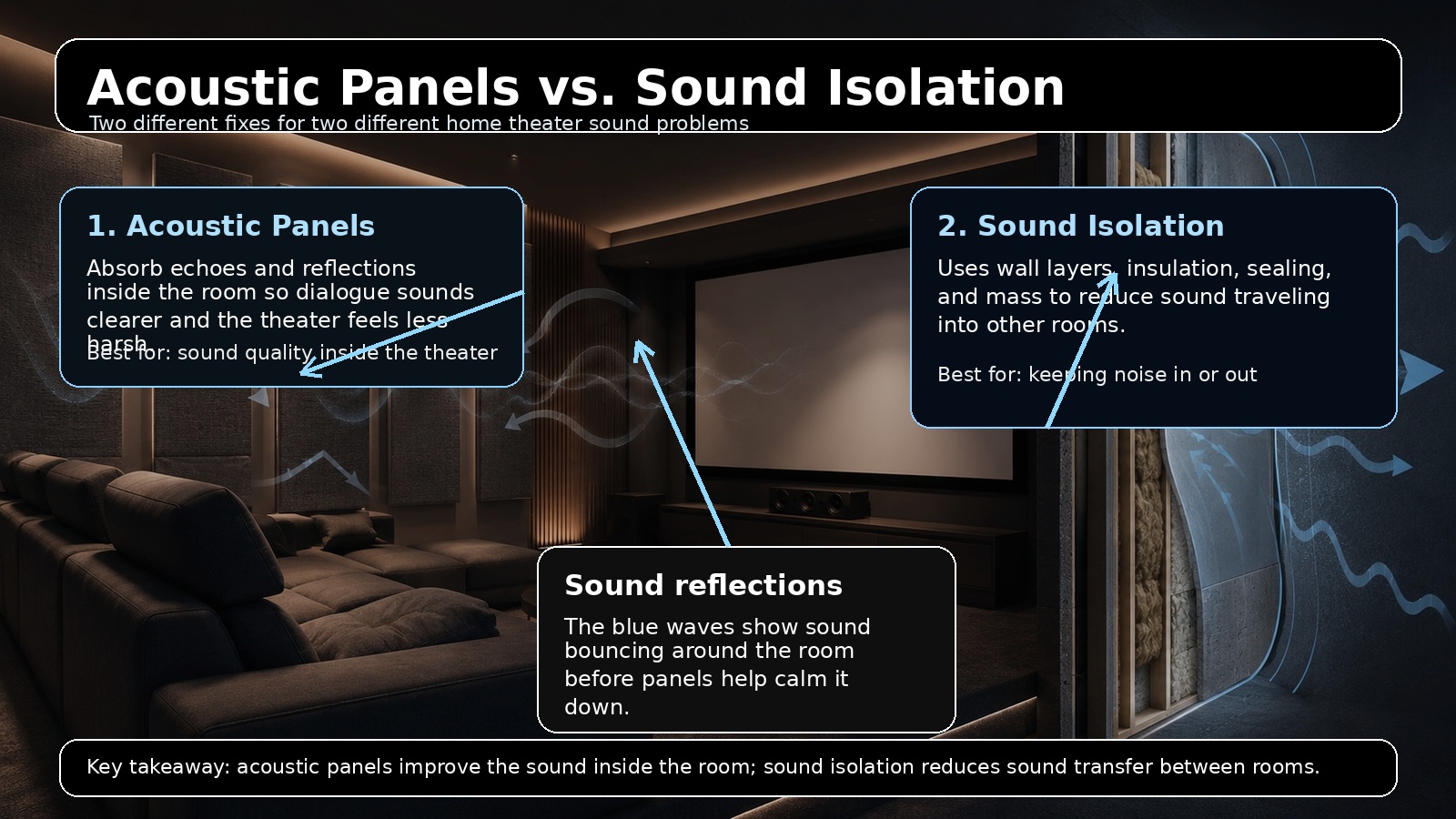
If you are building a home theater, it is easy to assume that acoustic panels and soundproofing are the same thing. They are not.
Acoustic panels help control the sound inside your room. They reduce echo, control reflections, and can make dialogue, music, and surround effects sound clearer.
Soundproofing, more accurately called sound isolation, helps prevent sound from entering or leaving the room. It stops movie explosions, subwoofer bass, traffic noise, footsteps, and household sounds from traveling through walls, ceilings, floors, doors, and gaps.
Both can matter in a home theater, but they address different problems. If you are planning a full media room, this article pairs well with my guide to Home Theater Accessories and Decor, as seating, lighting, sound, wall design, and room layout all affect the final experience.
If your room sounds harsh, echoey, or muddy, you probably need acoustic treatment. If your family can hear every movie upstairs or your neighbors can feel the bass through a shared wall, you need sound isolation.
This guide explains the difference, what each one does, what actually works, and how to decide what your home theater needs first.
Acoustic Panels vs. Soundproofing: The Short Answer
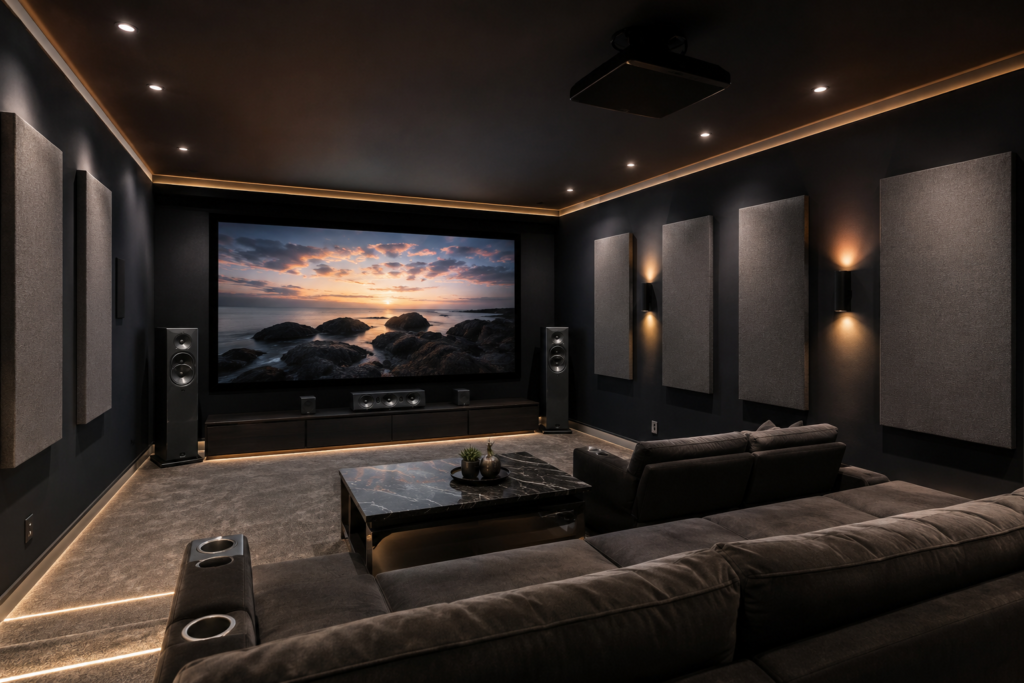
For most home theaters, you need some acoustic treatment and possibly some sound isolation.
If your goal is better sound quality inside the room, start with acoustic panels, bass traps, rugs, curtains, furniture placement, and speaker setup.
If your goal is keeping sound from escaping the room, acoustic panels alone will not solve the problem. You need construction-based improvements such as sealing gaps, upgrading doors, adding mass, decoupling walls or ceilings, using insulation inside assemblies, and controlling flanking paths.
A simple way to remember the difference is this: acoustic panels improve how the room sounds, while sound isolation controls how much sound travels in or out of the room.
| Goal | What you need |
|---|---|
| Reduce echo inside the room | Acoustic panels |
| Improve dialogue clarity | Acoustic treatment |
| Make surround sound more accurate | Acoustic treatment and proper placement |
| Stop sound from bothering other rooms | Sound isolation |
| Reduce subwoofer bass transmission | Sound isolation, mass, decoupling, and bass management |
| Block outside noise from entering | Sound isolation |
What Acoustic Panels Actually Do
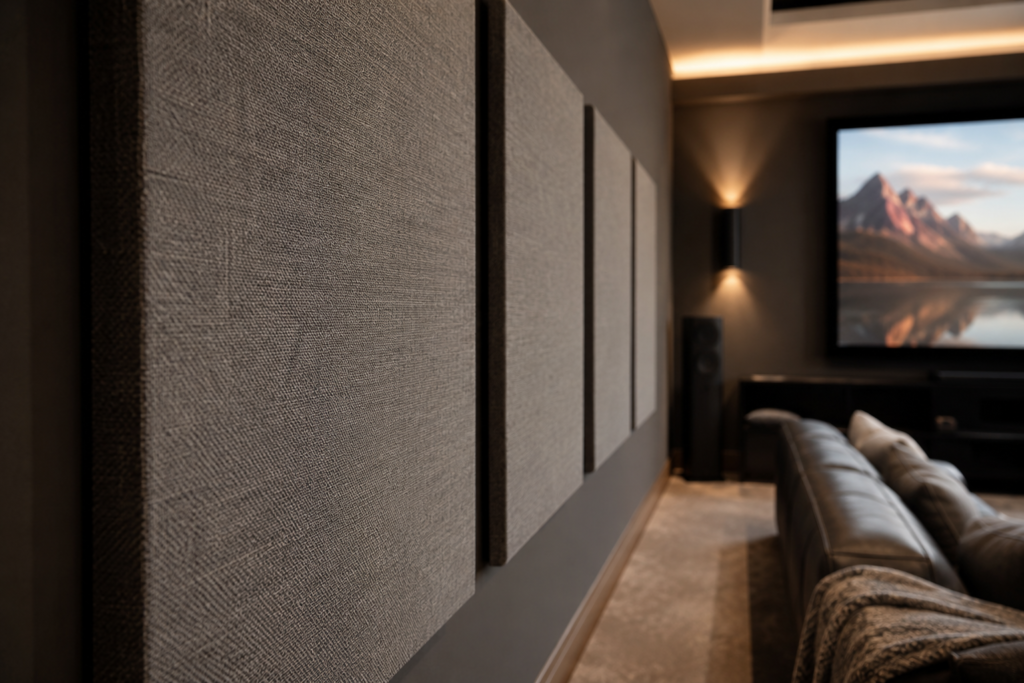
Acoustic panels absorb sound reflections inside a room.
When sound comes out of your speakers, it does not travel only in a straight line to your ears. It also bounces off walls, ceilings, floors, windows, and furniture. In a home theater, too many reflections can make the room sound bright, echoey, harsh, or unclear.
This is especially noticeable with dialogue. If voices sound smeared or hard to understand, the issue may not be your center speaker. It may be the room.
Acoustic panels reduce some of those reflections so you hear more of the direct sound from the speakers and less of the sound bouncing around the room.
They can help with:
- Echo
- Flutter echo
- Harshness
- Dialogue clarity
- Reverberation
- Early reflections
- Soundstage accuracy
- Overall listening comfort
They do not usually stop sound from leaving the room.
That is the biggest misconception. A wall covered in acoustic panels may sound better inside the theater, but it will not magically keep a subwoofer from shaking the room next door.
Helpful Amazon searches for acoustic treatment
If your room sounds echoey, harsh, or unclear, acoustic treatment can help make dialogue and surround sound easier to hear. Start with panels for reflection points, then consider bass traps, rugs, curtains, and soft furnishings if the room still feels too reflective.
- Acoustic Panels for Home Theater — best for reducing echo and reflections
- Bass Traps for Corners — best for helping control low-frequency buildup
- Acoustic Foam Panels — best for budget-friendly echo control in smaller areas
What Sound Isolation Actually Does
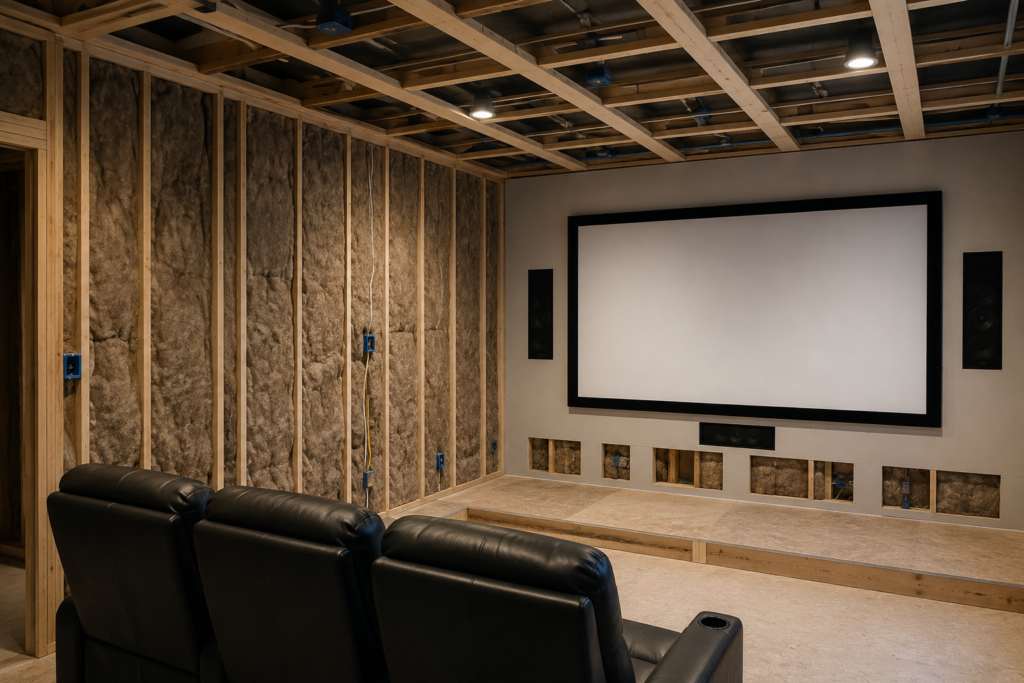
Sound isolation is about reducing sound transfer between spaces.
In a home theater, sound can escape through:
- Walls
- Ceilings
- Floors
- Doors
- Windows
- Vents
- Electrical outlets
- Recessed lights
- Gaps around trim
- Framing connections
- HVAC ductwork
Good sound isolation is not about one magic material. It is about the whole room assembly.
To isolate sound, you usually need some combination of:
- Mass: Heavier walls, doors, or layers help block airborne sound.
- Decoupling: Separating structures reduces vibration transfer.
- Damping: Damping compounds can reduce vibration between layers.
- Absorption inside cavities: Insulation inside wall or ceiling cavities can reduce resonance.
- Sealing: Even small air gaps can allow sound to leak.
- Flanking control: Sound can travel around the treated wall through floors, ceilings, vents, or framing.
This is why soundproofing a home theater is more complicated than hanging panels. True isolation often needs to be planned before drywall goes up.
For more planning mistakes that can affect the finished room, see our guide to Home Theater Mistakes to Avoid.
Acoustic Panels vs. Soundproofing: The Big Difference
Think of acoustic panels as improving the sound within the room.
Think of soundproofing as controlling sound between rooms.
Acoustic panels are like adding curtains to reduce glare on a screen. They improve the experience, but they do not change the structure of the house.
Sound isolation is more like building a better wall, door, or ceiling assembly. It is structural. It addresses mass, vibration, air leaks, and how sound travels through the building.
Here is the easiest comparison:
| Feature | Acoustic Panels | Sound Isolation |
|---|---|---|
| Main job | Absorb reflections | Block sound transfer |
| Helps inside-room sound | Yes | Sometimes |
| Keeps the sound from leaving | Not much | Yes, when done correctly |
| Helps dialogue clarity | Yes | Not directly |
| Helps with bass escaping | Very limited | Yes, but difficult |
| Usually DIY-friendly | Yes | Sometimes, depending on scope |
| Best installed before drywall | Not necessary | Often yes |
| Common rating | NRC | STC |
What Is NRC?
NRC stands for Noise Reduction Coefficient. It is a rating that describes how much sound a material absorbs.
In simple terms, a higher NRC generally means a material absorbs more sound instead of reflecting it back into the room. Acoustic wall panels, ceiling panels, and some acoustic materials often list an NRC rating.
For home theaters, NRC can be useful when comparing acoustic panels, but it is not the whole story. NRC is mainly about absorption in certain frequency ranges. A panel with a high NRC may absorb midrange and high-frequency sound well, but it may not do much for deep bass.
That matters because home theaters produce a lot of low-frequency energy from subwoofers, explosions, music, and cinematic effects.
A good acoustic plan usually uses more than thin wall panels. It may include thicker panels, bass traps, rugs, curtains, upholstered furniture, and careful placement of speakers and seating.
What Is STC?
STC stands for Sound Transmission Class. It is a rating that describes how well a wall, door, window, floor, or ceiling assembly reduces airborne sound transmission.
A higher STC generally means better sound isolation for typical airborne sound. For example, a better door or wall assembly may have a higher STC than a lightweight hollow-core door or thin wall.
But STC has limitations for home theaters. It does not fully capture the challenge of deep bass. A wall assembly can have a respectable STC rating and still let low-frequency subwoofer energy travel through the structure.
That is why home theater isolation is different from simply blocking speech or everyday household noise. Bass is harder to stop. It requires mass, decoupling, airtight construction, and careful design.
Will Acoustic Panels Soundproof a Home Theater?
No, not in the way most people mean.
Acoustic panels can improve the room’s sound. They can reduce echo and improve clarity. But they are not designed to block sound from traveling through walls.
If someone is selling thin foam squares as “soundproofing,” be cautious. Foam can absorb some sound reflections inside the room, especially higher frequencies, but it does not add enough mass or isolation to stop loud movie sound from leaving the space.
This does not mean panels are useless. They are very useful for sound quality. They just solve a different problem.
Use acoustic panels when your room sounds bad.
Use sound isolation when your room is bothering other people.
What Home Theaters Usually Need First
Most home theaters benefit from acoustic treatment first, especially if the room is already finished.
That might include:
- Panels at first reflection points
- A rug or carpet if the floor is hard
- Thick curtains over windows
- Bass traps in corners
- Absorption or diffusion on the rear wall
- Better center speaker placement
- Moving seating away from the back wall
- Calibrating speakers and subwoofers
These upgrades can make a room sound more balanced without major construction.
Once the room sounds more controlled, the next step is making the space comfortable. Small details like trays, cup holders, storage, blankets, and side tables can make the room more usable, especially for family movie nights. For ideas, see my guide to Home Theater Seating Accessories.

However, if you are still building the room, sound isolation should be considered before finishes go in. It is much easier to isolate sound before drywall, flooring, doors, and trim are complete.
If you wait until after the room is finished, your options become more limited and more expensive.
Where to Put Acoustic Panels in a Home Theater
Acoustic panel placement matters. Randomly covering every wall is not always the best approach.
The most common starting points are the first reflection points. These are the spots on the side walls and ceiling where sound from the front speakers bounces before reaching your ears.
A simple way to find side-wall reflection points is the mirror trick. Sit in the main listening position and have someone move a mirror along the side wall. Wherever you can see a speaker in the mirror, that area is a reflection point.
Common acoustic treatment locations include:
Side walls
Place panels at the first reflection points for the left, center, and right speakers. This can improve clarity and imaging.
Ceiling
A ceiling cloud above the seating area can reduce vertical reflections, especially in rooms with low or reflective ceilings.
Rear wall
The wall behind the seats can create strong reflections, especially if the seating is close to it. Depending on the room, this area may need absorption, diffusion, or a combination.
Corners
Corners are common places for bass buildup. Bass traps can help smooth low-frequency response, though subwoofer placement and calibration also matter.
Front wall
Some home theaters benefit from absorption behind the screen or front speakers, especially if the front wall is reflective or the speakers are close to it.
Acoustic panels can also become part of the room’s design. If you are trying to make the space feel finished instead of technical, pair fabric panels with intentional decor, framed posters, sconces, or themed wall details. For inspiration, see my guide to Home Theater Wall Decor Ideas.
How Much Acoustic Treatment Do You Need?
More is not always better.
A room with too little treatment can sound echoey and harsh. A room with too much absorption can sound dull, flat, or lifeless.
For many home theaters, the goal is balance. You want to reduce problem reflections without making the room feel dead.
A good starting point is to treat the first reflection points, add some bass control, soften hard surfaces, and then listen. If dialogue becomes clearer and the room feels more controlled, you may not need to cover every surface.
The right amount depends on:
- Room size
- Wall and floor materials
- Ceiling height
- Speaker layout
- Seating position
- Subwoofer placement
- Whether the room is open or enclosed
- How loud you listen
A small room with drywall, hardwood floors, and bare windows will usually need more treatment than a carpeted room with curtains, bookshelves, and upholstered seating.
Why Bass Is the Hardest Problem
Bass is the reason home theater sound isolation gets tricky.
Low-frequency sound has long wavelengths and carries a lot of energy. It can travel through walls, floors, ceilings, framing, and even connected structures. This is why someone in another room may not hear every word of dialogue but can still feel the thump of the subwoofer.
Bass also behaves unevenly inside small rooms. Some seats may have too much bass, while others have almost none. This is caused by room modes, seating position, speaker placement, and subwoofer placement.
To improve bass inside the room, you may need:
- Better subwoofer placement
- Multiple subwoofers
- Bass traps
- Room correction
- Seating away from the back wall
- Proper crossover settings
To reduce bass leaving the room, you may need:
- More mass
- Decoupled construction
- Sealed gaps
- Isolated doors
- Treated ceilings and floors
- Careful HVAC planning
Bass is not impossible to control, but it is rarely solved by thin panels alone.
Sound Isolation Upgrades That Actually Help
If your main goal is keeping home theater sound from traveling, these upgrades are more relevant than decorative panels.
Seal air gaps
Sound travels through air leaks. Gaps around doors, outlets, trim, recessed lights, and vents can weaken an otherwise solid wall or ceiling. Acoustic sealant, weatherstripping, door gaskets, and careful caulking can help.
Upgrade the door
A hollow-core door is often one of the weakest points in a room. A solid-core door with good seals and an automatic door bottom can make a noticeable difference.
Add mass
Heavier assemblies generally block more airborne sound. In construction, this may mean additional drywall layers, dense materials, or specialty sound-isolation products.
Decouple the structure
Decoupling reduces the vibration path between one side of a wall or ceiling and the other. This can involve isolation clips, hat channel, staggered studs, double-stud walls, or other construction methods.
Use damping between layers
Damping compounds between drywall layers can help reduce vibration. This is usually part of a larger assembly, not a standalone fix.
Insulate wall and ceiling cavities
Insulation inside cavities can help reduce resonance and improve the performance of a wall or ceiling assembly. It works best as part of a complete isolation strategy.
Control flanking paths
Sound may bypass the wall you treated by traveling through floors, ceilings, ductwork, plumbing, or framing. Flanking paths are one reason partial soundproofing projects sometimes disappoint.
If you are also planning lighting, remember that recessed lights, wall sconces, and ceiling fixtures can affect the room layout and sometimes create gaps where sound can leak. For design ideas, see my guide on How to Layer Lighting in a Home Theater.
What Usually Does Not Work
Some products are useful for acoustics but overpromised for soundproofing.
Be cautious with:
- Thin foam tiles marketed as soundproofing
- Lightweight peel-and-stick panels that claim to block bass
- Blankets hung on walls as a complete soundproofing solution
- Curtains advertised as fully soundproof
- Treating only one wall and expecting the whole room to be isolated
- Ignoring the door
- Ignoring vents
- Ignoring subwoofer placement
- Buying panels before understanding the problem
Acoustic foam and lightweight panels can have a place, but they are not a substitute for proper isolation.
Helpful Amazon searches for basic sound-isolation upgrades
Sound isolation is harder than acoustic treatment, but small upgrades can still help with common weak spots. Focus on sealing gaps, improving door edges, and reducing obvious air leaks before buying decorative panels.
- Acoustic Sealant — best for sealing small gaps where sound can leak
- Door Weatherstripping — best for reducing gaps around doors
- Automatic Door Bottom — best for sealing the gap under a theater door
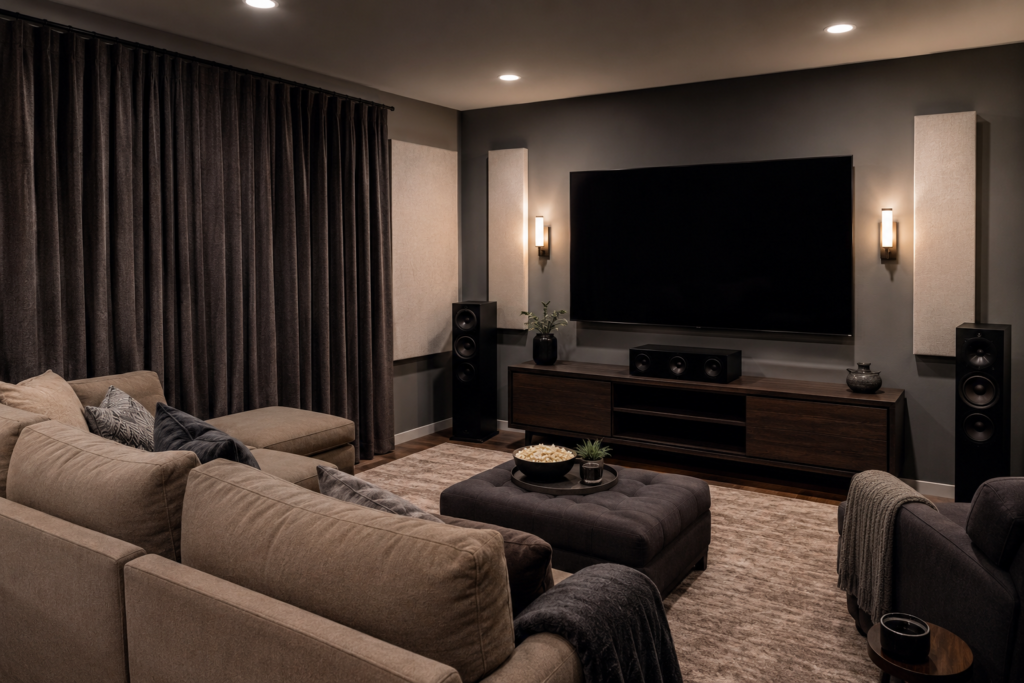
Acoustic Curtains, Rugs, and Furniture: Do They Help?
Yes, but mostly for room acoustics, not true soundproofing.
Thick curtains can reduce reflections from windows and make a room feel less bright. Rugs and carpet can reduce floor reflections. Upholstered furniture can add some absorption. Bookshelves and irregular surfaces can help scatter sound.
These are good, practical upgrades for living-room theaters or multipurpose spaces.
They can help the room sound more comfortable, but they should not be expected to block loud movie sound from escaping.
Helpful Amazon searches for soft acoustic upgrades
Soft surfaces can help reduce reflections in living-room theaters and multipurpose spaces. They will not truly soundproof the room, but they can make the space sound more comfortable and less echoey.
- Thick Area Rugs for Living Rooms — best for reducing floor reflections
- Heavy Blackout Curtains — best for softening window reflections and controlling light
- Upholstered Storage Ottoman — best for adding comfort, storage, and soft surfaces
Should You DIY or Hire a Pro?
Acoustic treatment is often DIY-friendly. Many homeowners can add panels, rugs, curtains, bass traps, and better speaker placement themselves.
Sound isolation is more complicated. If you are building a dedicated theater, finishing a basement, sharing walls with neighbors, or trying to contain a powerful subwoofer, it may be worth consulting an acoustics professional or experienced home theater designer.
You should especially consider professional help if:
- You are building from scratch
- You want a truly isolated room
- The theater is below the bedrooms
- The room shares a wall with neighbors
- You plan to use multiple subwoofers
- You have a high-output speaker system
- You need permits or construction work
- You are changing walls, ceilings, or HVAC
It is much cheaper to design isolation correctly the first time than to fix a finished room later.
Best Order of Operations for a Home Theater
If you are planning a home theater, follow this order:
1. Decide how loud the room will be
A casual TV room does not need the same isolation as a dedicated theater with a large subwoofer system.
2. Identify who or what you are trying to protect from noise
Are you worried about bedrooms upstairs? A shared apartment wall? Street noise coming in? A baby’s room? The answer changes the strategy.
3. Plan sound isolation before finishes
If isolation matters, address walls, ceilings, floors, doors, and HVAC before the room is finished.
4. Set speaker and seating positions
Speaker placement and seating placement affect both sound quality and the amount of treatment you need.
5. Add acoustic treatment
Start with first reflection points, bass control, and obvious hard surfaces.
6. Calibrate the system
Use your receiver’s room correction tools, then fine-tune speaker levels, crossovers, and subwoofer settings.
7. Add lighting, seating, and decor
Once the room sounds good, add the details that make the space comfortable and complete. That includes layered lighting, wall decor, seating accessories, snack storage, and small touches that make the room feel like a destination.
For more inspiration, read my guides on How to Layer Lighting in a Home Theater, Home Theater Wall Decor Ideas, and Creating a Luxury Home Theater Experience.
Do You Need Acoustic Panels If You Have a Soundbar?
Yes, possibly.
Even a soundbar can sound better in a room with fewer harsh reflections. If your room has hard floors, bare walls, glass, and minimal furniture, acoustic treatment can still help.
That said, full acoustic treatment matters more in a surround-sound system or a projector room, where you are trying to create a more immersive experience.
For a soundbar-based living room, start simple:
- Add a rug
- Use curtains
- Avoid placing seating directly against the back wall
- Add soft furnishings
- Consider a few discreet wall panels if the room sounds echoey
Helpful Amazon searches for soundbar-friendly room treatment
Even a simple soundbar setup can sound better when the room has fewer hard, reflective surfaces. If your living room has bare floors, windows, and empty walls, start with soft, simple upgrades before making the room complicated.
- Small Acoustic Wall Panels — best for discreet echo control near seating areas
- Living Room Area Rug — best for softening hard floors
- Curtains for Media Room — best for reducing reflections from windows
Do You Need Soundproofing If You Use Headphones?
Probably not.
If you mostly watch with headphones, sound isolation may not be a priority. But if you use speakers, especially a subwoofer, sound transfer can become an issue quickly.
Subwoofers are the main reason home theater sound bothers other people. Even at moderate volume, bass can travel farther than expected.
Final Recommendation
If you are building a home theater, do not treat acoustic panels and sound isolation as interchangeable. They do different jobs.
Use acoustic panels to improve the sound in your theater. They help with echo, reflections, dialogue clarity, and overall listening comfort.
Use sound isolation to keep theater sound from traveling into bedrooms, neighboring units, or the rest of the house. That requires sealing, mass, decoupling, damping, better doors, and attention to the entire room assembly.
For most finished rooms, start with acoustic treatment because it is easier, more affordable, and can improve the experience quickly. For new construction or basement theaters, plan for sound isolation first, as it is much harder to add later.
The best home theater is not just loud. It is controlled, clear, comfortable, and considerate of the surrounding spaces.
FAQ
Are acoustic panels the same as soundproofing?
No. Acoustic panels absorb reflections inside a room. Soundproofing, or sound isolation, reduces sound transfer between rooms.
Will acoustic panels stop my neighbors from hearing my home theater?
Usually not. Acoustic panels may reduce echo inside your room, but they do not add enough mass or isolation to block loud sound from traveling through walls.
What is better for a home theater: acoustic panels or bass traps?
Most home theaters benefit from both. Acoustic panels help with reflections and clarity, while bass traps help control low-frequency buildup. Bass traps are especially useful in small rooms and corners.
Do I need acoustic panels behind the TV?
Maybe. Some rooms benefit from absorption on the front wall, especially if the speakers are close to it. However, side-wall first reflection points and the rear wall are often more important places to start.
Can curtains soundproof a room?
Heavy curtains can reduce reflections and slightly reduce some sound, but they do not truly soundproof a room. They are better thought of as acoustic treatment than sound isolation.
What is the cheapest way to improve home theater sound?
Start with speaker placement, seating placement, a rug, curtains, and a few acoustic panels at first reflection points. These changes can improve clarity without major construction.
What is the cheapest way to reduce sound leaving a room?
Start by sealing gaps and improving the door. Weatherstripping, door sweeps, and a solid-core door can help, especially if the current door is hollow or poorly sealed.
Why can I hear bass in other rooms even when the dialogue isn’t that loud?
Bass travels through structures more easily than higher-frequency sounds. Subwoofer energy can pass through walls, floors, ceilings, and framing, making it harder to isolate than voices.
Should I soundproof before or after installing a home theater?
If sound isolation matters, plan it before the room is finished. It is much easier to build isolation into walls, ceilings, floors, doors, and HVAC systems than to retrofit later.
Are foam panels good for home theaters?
Foam panels can reduce some high-frequency reflections, but they are not a complete acoustic solution and do not provide soundproofing. For a serious home theater, thicker broadband panels and bass traps are usually more effective.
What should I buy first for a home theater: seating or acoustic panels?
If the room is echoey or dialogue is hard to understand, start with acoustic treatment. If the room already sounds decent, seating may be the more noticeable comfort upgrade. For seating accessories and comfort ideas, see our guide to Home Theater Seating Accessories.
Related Articles
- Home Theater Accessories and Decor
- Home Theater Seating Accessories
- How to Layer Lighting in a Home Theater
- Home Theater Wall Decor Ideas
- Home Theater Mistakes to Avoid
- Creating a Luxury Home Theater Experience

Lisa is the creator of Home Cinema Living. Together with her husband, a longtime home theater professional, she has spent years designing and enjoying home theater spaces that bring family and friends together for memorable movie nights.