Affiliate disclosure: This post may contain affiliate links. As an Amazon Associate, I earn from qualifying purchases at no extra cost to you.
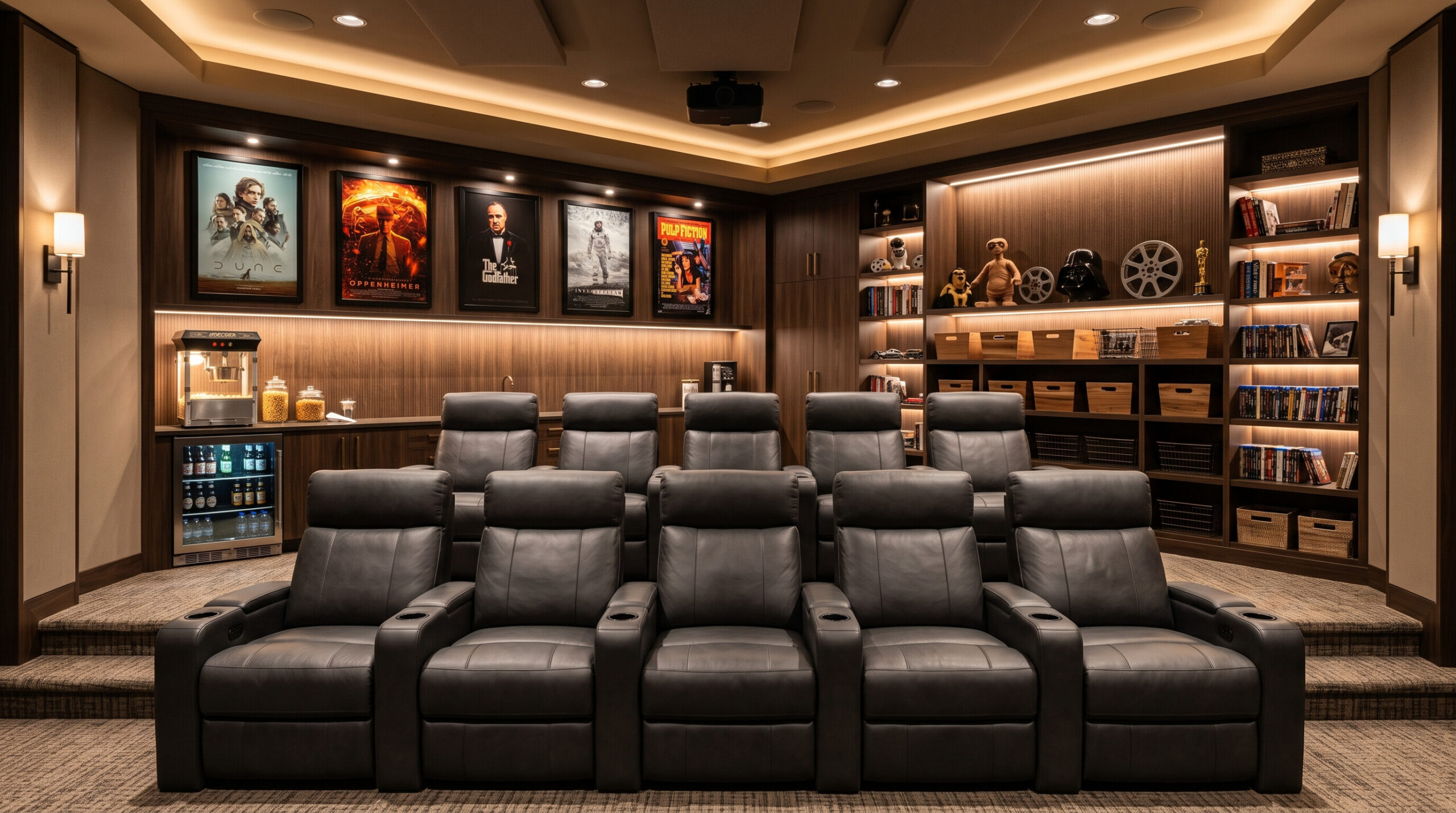
The wall behind your home theater seating is easy to overlook. Most of the attention naturally goes to the screen, speakers, seating, and lighting. Once those pieces are in place, however, the rear of the room can feel unfinished or gradually become a collection point for blankets, remotes, games, snacks, and extra accessories.
A thoughtfully planned back wall can make the theater more organized while giving the room a finished, intentional appearance. Depending on the available space, the wall can support an extra-long sofa table, concealed storage, a compact snack cabinet, a memorabilia display, or a coordinated built-in.
The goal is not to fill every available inch. The best home theater back wall ideas give the space one clear purpose while protecting the seating, walkways, speakers, doors, and equipment.
These five layouts offer practical options for small movie rooms, family media spaces, basement theaters, and dedicated home cinemas.
Plan the Space Before Choosing a Layout
Measure the rear of the room before purchasing furniture, cabinetry, or shelving. The wall may appear to have plenty of space while the chairs are upright, but reclining seats can reduce the available depth considerably.
Check:
- The width and height of the usable wall
- The distance behind fully extended recliners
- The main walkway through the room
- Doors, windows, vents, outlets, and switches
- Rear and surround-speaker positions
- Cabinet-door and drawer clearance
- Electrical and cable requirements
- Access needed for equipment maintenance
Follow the seating manufacturer’s clearance recommendations rather than estimating how far each chair will move.
It also helps to choose one main purpose for the wall. Storage and display can work together, as can cabinetry and a compact snack counter. Trying to combine a beverage bar, equipment rack, blanket station, poster gallery, collectibles, signs, and several lighting treatments on one wall will usually make it feel crowded.
| Your Main Need | Best Back-Wall Layout |
|---|---|
| A convenient surface directly behind the seats | Extra-long narrow sofa table |
| Concealed family storage | Closed movie-night storage wall |
| Convenient refreshments | Compact snack cabinet |
| Organized collectible display | Memorabilia display with hidden storage |
| One coordinated custom solution | Full back-wall built-in |
1. Place an Extra-Long Sofa Table Behind the Seating
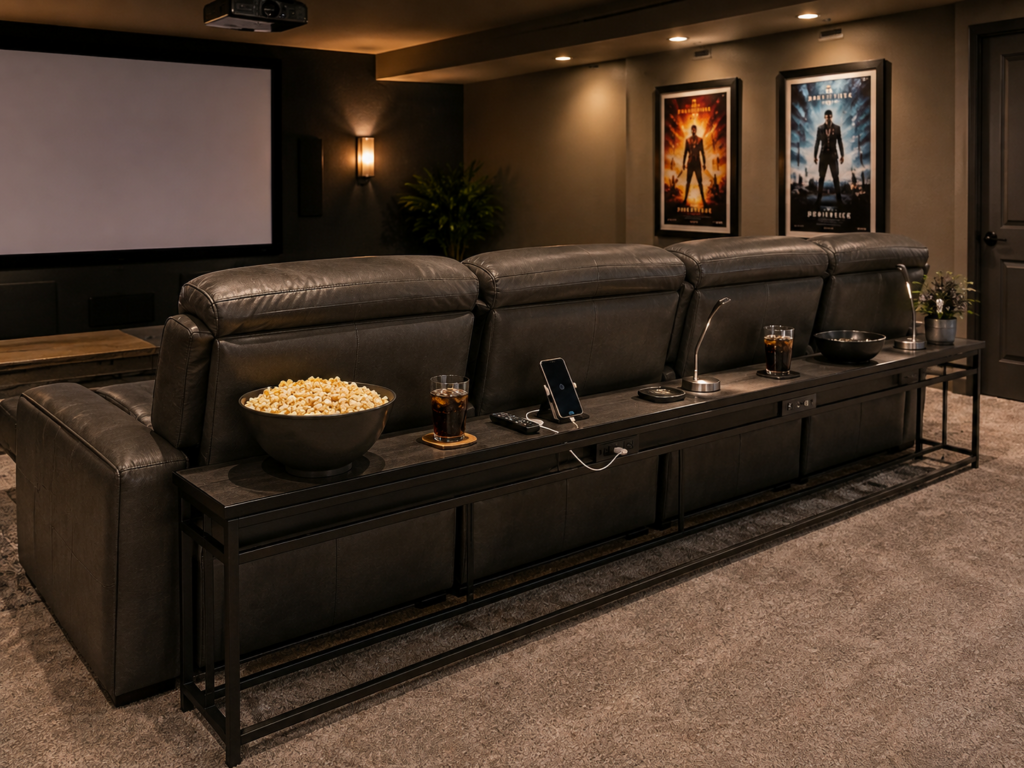
An extra-long, very shallow sofa table is one of the most practical ways to use the space directly behind a row of theater seats.
Unlike a traditional entryway console, this style of table is designed to fit within the narrow gap between a sofa and the wall. It can extend across most of the seating row without requiring the depth of a sideboard or storage cabinet.
The surface can hold:
- Drinks and popcorn bowls
- Remotes
- Phones and tablets
- Charging cables
- Small reading lights
- Napkins and coasters
- Temporary serving trays
This arrangement works particularly well behind a wide sofa, sectional, connected recliners, or wall-hugger theater seating.
Check the Height and Reclining Path
The tabletop should sit close to the height of the seat backs without creating an uncomfortable hard edge behind anyone’s head.
Do not assume that every recliner can be placed tightly against the table. Some seats move backward as they recline, while wall-hugger models move mainly forward. Extend every chair fully and confirm that the table will not interfere with the reclining mechanism.
The table should also be stabilized according to the manufacturer’s instructions. A long table with a very shallow base may be easier to tip than a standard console, especially when drinks, electronics, or lamps are placed on top.
Our Pick for Behind the Seating
SUPERJARE 102.3-Inch Extra-Long Narrow Sofa Table — Its slim 5.9-inch depth fits neatly behind wide sofas or theater seating, while built-in outlets and USB ports keep devices charged.
Measure the width and back height of your seating before ordering. The tabletop should remain accessible without interfering with headrests or moving recliner components.
Best for: Wide sofas, sectionals, connected recliners, wall-hugger seats, and rooms with limited depth.
2. Create a Closed Movie-Night Storage Wall
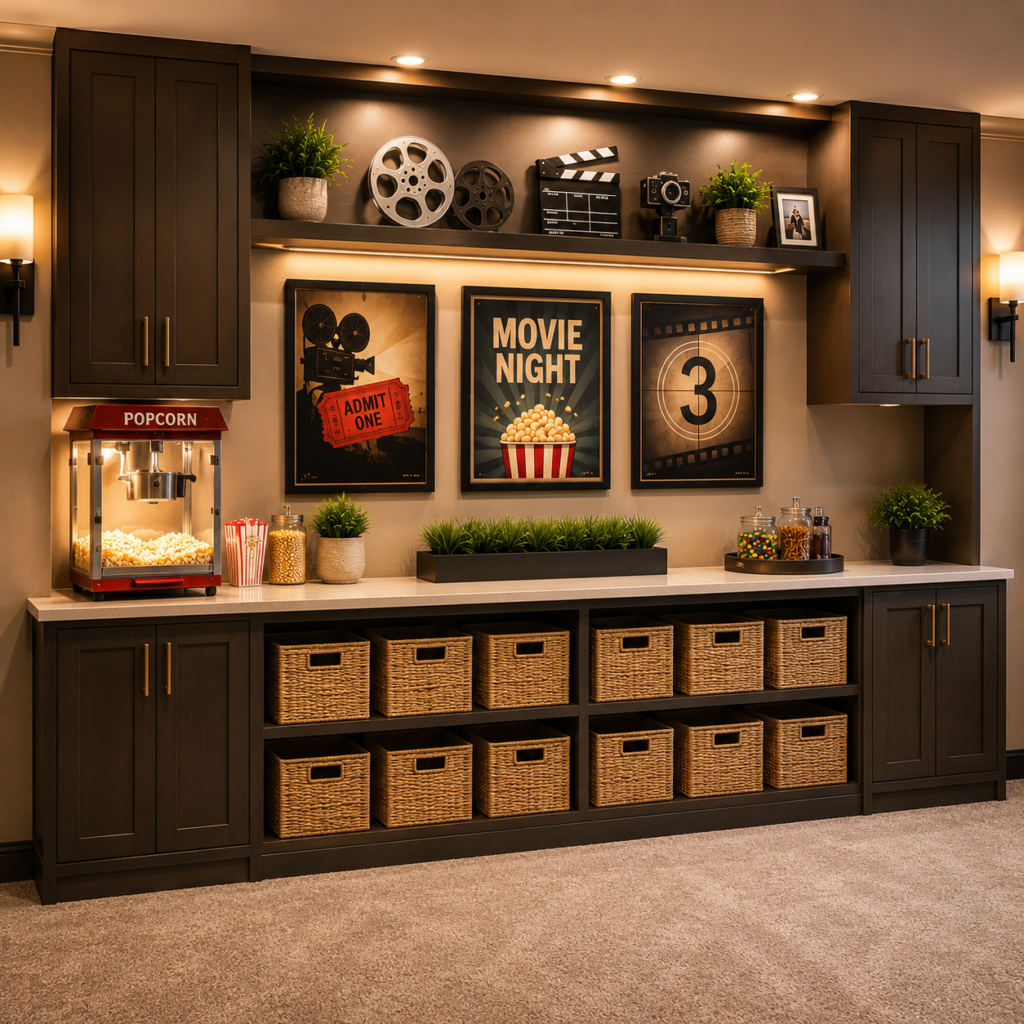
Family movie rooms often require more storage than expected. Blankets, pillows, trays, headphones, remotes, controllers, games, and serving supplies can quickly spread around the room.
A closed storage wall keeps those items near the seating without leaving everything visible.
This layout can be created with:
- A long sideboard
- Modular base cabinets
- Freestanding storage cabinets
- A combination of drawers and doors
- Tall cabinets at one or both ends
- A shallow countertop above lower cabinets
- Cubby shelving fitted with storage baskets
The goal is not necessarily to fill the entire wall. A shorter run of cabinets may provide plenty of storage while leaving room for a single poster, sconce, acoustic treatment, or decorative feature.
Organize the Cabinets by Purpose
Assigning each cabinet or drawer a specific job prevents small accessories from becoming mixed together.
Comfort storage: Keep blankets, small pillows, slippers, and seat covers together.
Control drawer: Store remotes, spare batteries, charging cords, and equipment instructions in one easy-to-find location.
Gaming storage: Use baskets or bins for controllers, headsets, games, and multiplayer accessories.
Serving storage: Keep popcorn bowls, trays, napkins, reusable cups, and coasters close to the seating.
Maintenance storage: Reserve a small drawer for microfiber cloths, screen-safe cleaning supplies, replacement batteries, and cable labels.
Labels do not need to be visible from the room. Small labels placed inside cabinet doors or drawers can help everyone return items to the proper location.
Helpful Amazon Searches for Back-Wall Storage
Cabinet dimensions vary considerably, so searches make more sense than recommending one sideboard for every room.
Long Sideboards With Doors and Drawers — useful for creating concealed storage without installing custom cabinetry
Black Collapsible Fabric Storage Cubes — useful for organizing blankets, headphones, gaming accessories, and serving supplies inside cubby shelves
Adjustable Drawer Organizers — useful for separating remotes, batteries, charging cables, and smaller accessories
Large Woven Storage Baskets — useful for adding warmer texture while keeping blankets and pillows contained
For a complete plan for organizing remotes, cables, snacks, equipment, and movie-night supplies, read How to Organize a Home Theater.
Best for: Family theaters, gaming rooms, children’s movie rooms, and frequently used media spaces.
3. Build a Compact Back-Wall Snack Cabinet
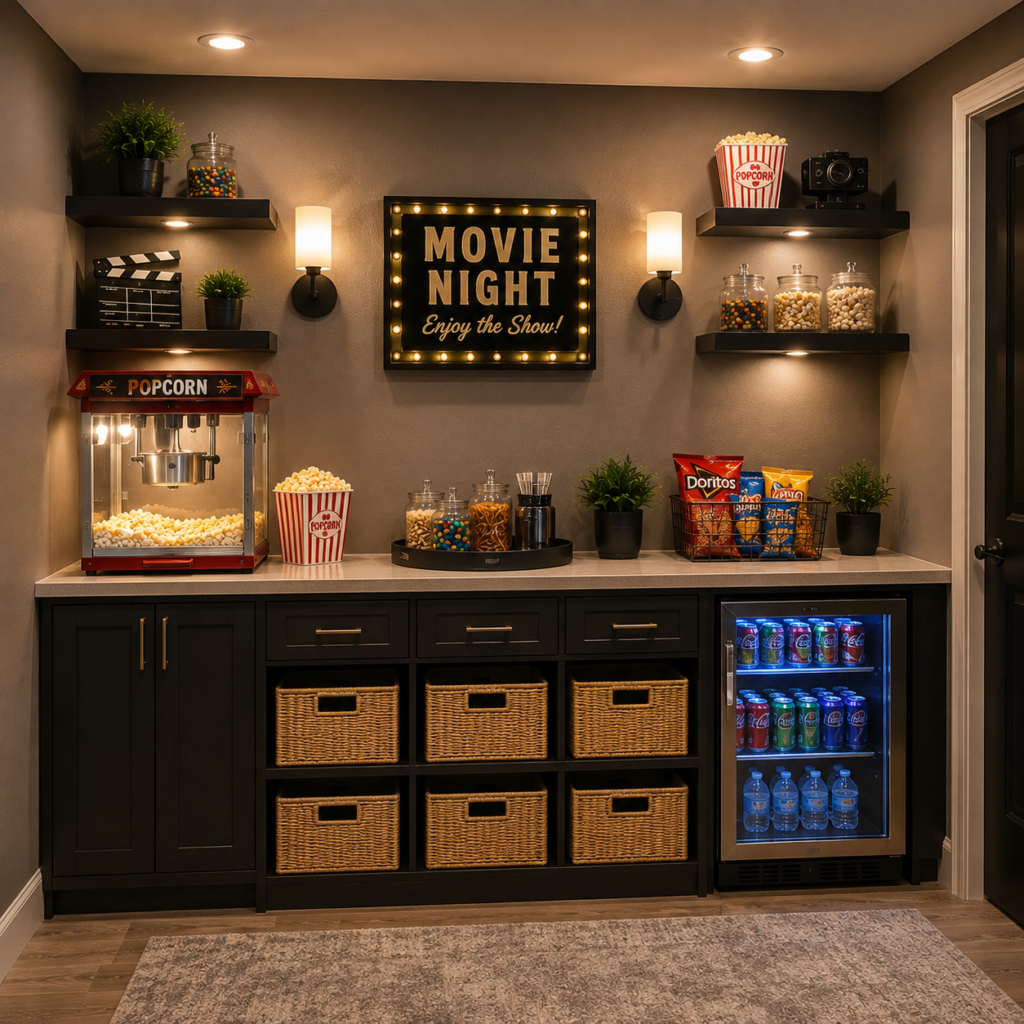
A home theater snack area does not need to resemble a full commercial concession stand. A short run of cabinets and a small countertop may provide enough room for popcorn, drinks, candy, napkins, and serving supplies.
A compact setup can include:
- Closed lower cabinets
- One or two drawers
- A wipeable countertop
- A countertop popcorn machine
- A limited number of candy containers
- Popcorn bowls or bags
- A compact beverage refrigerator
- Focused counter lighting
Keep most supplies behind cabinet doors and bring out additional candy, toppings, and serving pieces only when needed. This prevents the snack area from becoming a permanent wall of food packaging.
One noticeable feature, such as a classic popcorn machine, can establish the cinema theme without requiring multiple signs and decorative accessories.
Separate Food From Electronics
Avoid placing open food or drinks directly above an AV receiver, amplifier, power strip, or network equipment.
When snacks and electronics must share the back wall, divide them into separate cabinet zones. Electronics should remain ventilated and accessible, while snack supplies should be stored in easy-to-clean cabinetry.
Add Focused Lighting
Under-cabinet lighting can make it easier to prepare snacks without turning on bright overhead fixtures.
Choose warm, dimmable lighting and place it so the light source is not directly visible from the seating. The snack-area lights should be controlled separately so they can be switched off once the movie begins.
Our Popcorn Machine Pick
Great Northern Popcorn Matinee 8-Ounce Countertop Popcorn Machine — This theater-style countertop machine uses an eight-ounce kettle and provides a strong visual focal point without requiring a separate rolling cart. The black finish also coordinates easily with darker home theater cabinetry.
Helpful Amazon Searches for the Snack Cabinet
Dimmable Warm-White Under-Cabinet Lights — useful for illuminating the counter without turning on the main room lights
Compact Beverage Refrigerators — useful for storing canned drinks when the cabinet provides adequate ventilation
Movie-Night Candy Jars With Lids — useful for displaying a small, controlled selection of treats
Popcorn Bowls and Serving Trays — useful for keeping serving pieces together inside the cabinet
For more refreshment inspiration, read DIY Snack Stations for Home Theaters and Home Theater Popcorn Bar Ideas for the Ultimate Movie Night.
Best for: Dedicated theaters, finished basements, and entertainment rooms used for parties, sports, or family movie nights.
4. Combine a Memorabilia Display With Hidden Storage
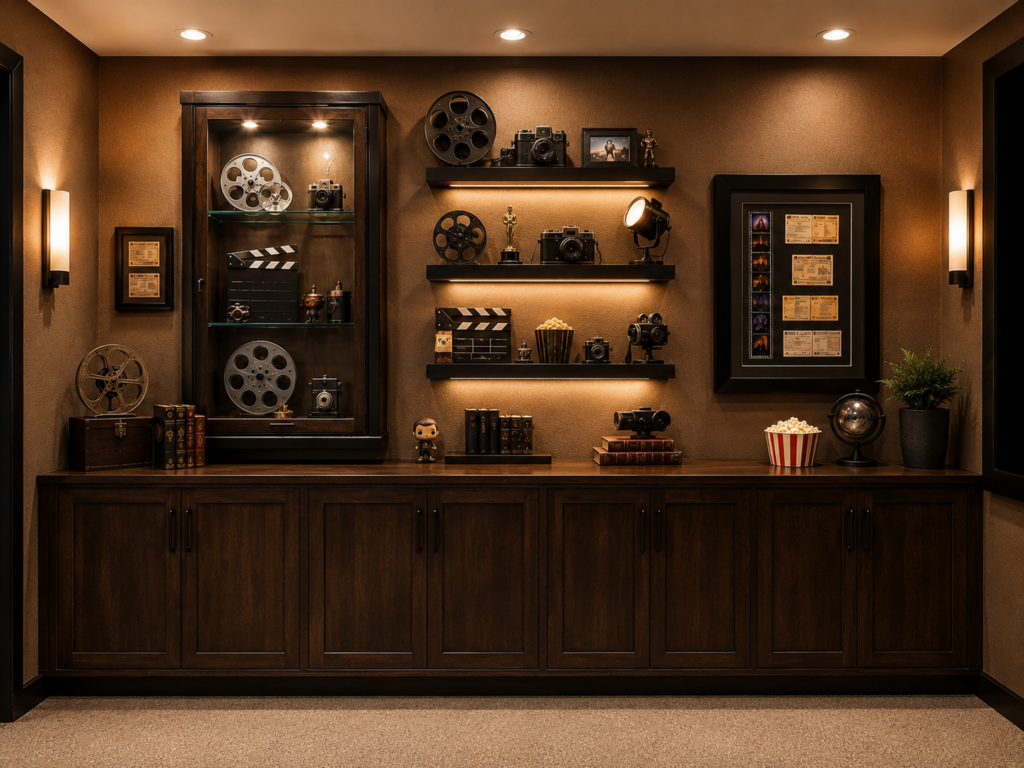
Movie memorabilia can give a home theater personality, but collections usually look more polished when only a limited number of pieces remain visible.
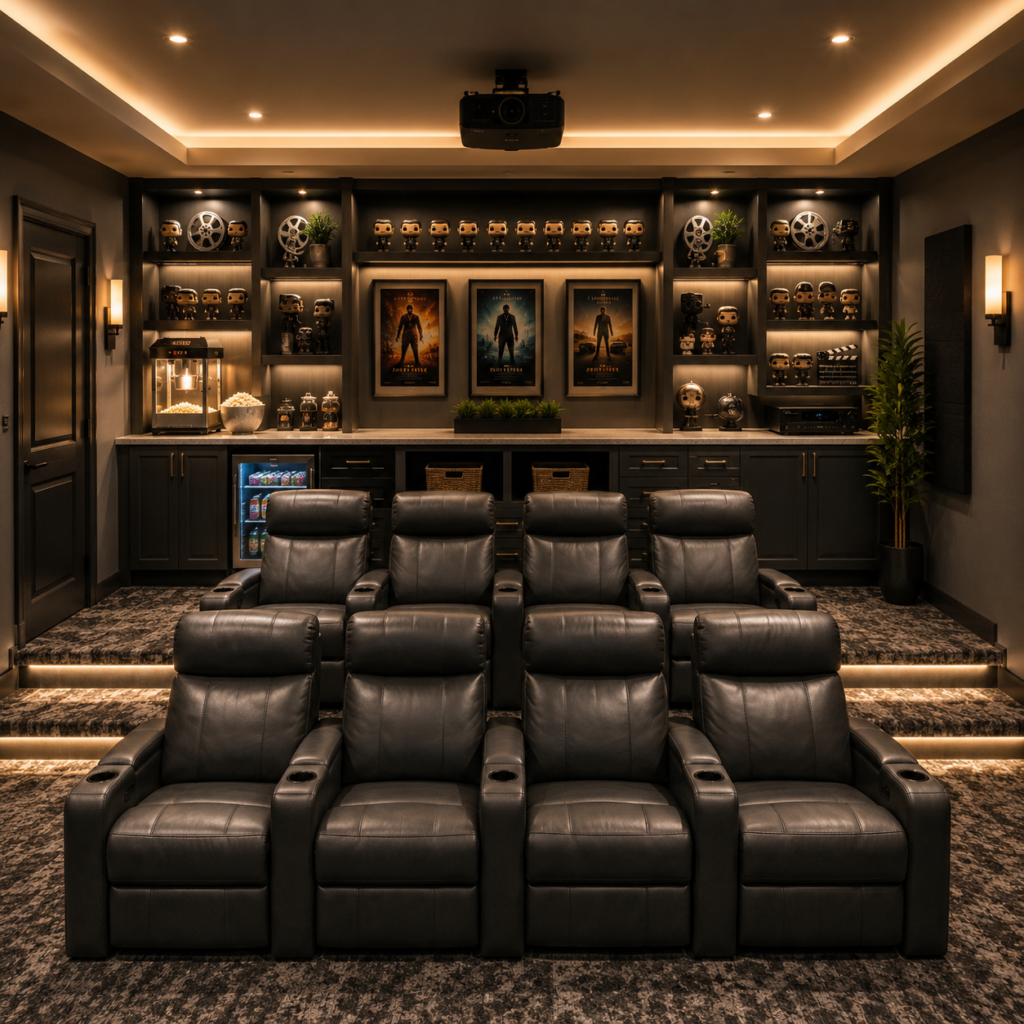
This layout combines a small display area with closed lower cabinetry. The storage becomes the primary function, while the collectibles provide one controlled decorative feature.
A balanced arrangement might include:
- Closed lower cabinets
- One enclosed display case
- One or two short floating shelves
- A framed ticket or prop display
- Subtle display lighting
- Open wall space around each grouping
The lower cabinets visually anchor the arrangement and conceal packaging, accessories, cleaning supplies, and items that are not currently being displayed.
Rotate the Collection
You do not need to display everything at once.
Consider rotating memorabilia by:
- Movie franchise
- Film genre
- Director or performer
- Holiday or season
- Current family movie marathon
- Color palette
Rotating the collection helps prevent the shelves from becoming overcrowded and gives individual pieces more attention.
Protect Fragile Items
Enclosed display cases and shadow boxes work well for signed pieces, small props, figures, vintage tickets, and collectibles with delicate parts.
Use properly anchored shelves and avoid placing heavy or breakable objects directly above seating. Check glass doors and framed displays from the viewing position to make sure they do not create distracting reflections.
This section should remain focused on storage planning and controlled display space. Detailed poster arrangements, decorative wall treatments, and styling techniques are covered separately in your existing wall-decor and memorabilia guides.
Helpful Amazon Searches for Memorabilia Storage
Wall-Mounted Collectible Display Cases — useful for protecting small figures, props, signed pieces, and miniature models
Movie Memorabilia Shadow Boxes — useful for displaying tickets, programs, small costume pieces, and flat collectibles
Short Floating Shelves With Concealed Brackets — useful for creating a limited display without covering the entire wall
Clear Museum Putty for Collectibles — useful for helping lightweight objects remain stable on shelves
For detailed guidance on arranging and protecting posters, props, tickets, and collectibles, read How to Use Movie Posters and Memorabilia. For broader inspiration involving feature walls, sconces, acoustic décor, signs, and framed artwork, read Home Theater Wall Decor Ideas.
Best for: Film collectors, themed theaters, classic cinema rooms, and anyone who wants to display a collection without making the room feel crowded.

5. Install a Full Back-Wall Built-In
A full built-in is the most complete back-wall solution. Instead of adding unrelated furniture, shelves, snack carts, and equipment cabinets over time, the entire wall is designed as one coordinated feature.
A custom built-in may include:
- Closed base cabinets
- Tall storage cabinets
- A central snack counter
- Limited display niches
- An equipment section
- Adjustable shelving
- Integrated lighting
- A beverage refrigerator
- Ventilation openings
- Removable cable-access panels
The wall still needs a clear hierarchy. One feature should attract attention while the remaining cabinetry provides a quieter background.
For example, a central snack counter could be framed by closed cabinets. One display case could sit above a long countertop. A small memorabilia niche could occupy one side while the rest of the wall remains dedicated to concealed storage.
Use Different Cabinet Depths
A built-in does not need to be equally deep across the entire wall.
Tall cabinets can be placed at the ends where they are less likely to interfere with the walkway. Shallower base cabinets or a narrow counter can occupy the area directly behind the seating.
Varying the depth helps the built-in feel less bulky and allows it to work around doors, vents, speakers, and reclining chairs.
Keep Equipment Accessible
Do not permanently seal receivers, amplifiers, network equipment, lighting controllers, or electrical connections behind finished panels.
Equipment areas need:
- Airflow around the components
- Space behind cables
- Access to outlets and connections
- Removable shelves or panels
- Room to replace components
- A path for cooler air to enter
- A path for warm air to escape
Always follow the ventilation and clearance instructions supplied with each component.
Our Pick for Equipment Ventilation
AC Infinity AIRPLATE T3 Cabinet Cooling Fan With Temperature Controller — This six-inch cooling system is designed for AV and home theater cabinets. It includes a temperature controller and can help move warm air from a properly designed equipment enclosure.
A cabinet fan does not replace equipment clearance or correctly positioned ventilation openings. The enclosure still needs a path for cooler air to enter and warm air to escape.
For more information about heat and airflow, read Home Theater Ventilation and Temperature Control.
Best for: Dedicated theaters, new construction, larger renovations, and rooms where several functions need to share one wall.
Plan Wiring Before Adding Furniture or Cabinets
The back wall may need power for charging stations, lighting, a beverage refrigerator, a popcorn machine, powered seating, speakers, or AV equipment.
Plan these connections before attaching cabinetry or closing the wall.
Consider:
- Outlets above and below counters
- USB charging access
- Speaker wiring
- Network connections
- Lighting controls
- Cable paths between cabinets
- Surge protection
- Future equipment upgrades
Do not permanently enclose plugs, adapters, or power strips where they cannot be reached. Electrical work should comply with local requirements and may need to be completed by a qualified electrician.
In a finished room, surface-mounted cable raceways can conceal visible low-voltage wires without opening the drywall. Keep connections accessible so components can be repaired or replaced later.
Helpful Amazon Searches for Cable Management
Paintable Cable Raceway Kits — useful for hiding visible speaker, network, and signal cables along a finished wall
Cable Management Boxes — useful for concealing accessible power strips and extra cord length inside or behind cabinetry
Reusable Hook-and-Loop Cable Ties — useful for grouping cables without permanently fastening them together
Write-On Cable Labels — useful for identifying equipment connections during maintenance or upgrades
For more detailed options, read Hidden Cable Management Ideas for a Clean Home Theater Setup.
Keep the Back Wall Visually Balanced
Even a practical storage wall contributes to the overall appearance of the theater. Cabinet color, hardware, lighting, artwork, and countertop materials should feel connected to the rest of the room.
A simple formula can help.
Choose One Main Function
Decide whether the wall is primarily intended for seating convenience, storage, refreshments, display, or equipment.
Add One Focal Point
Use one poster arrangement, display case, popcorn machine, or illuminated niche to attract attention.
Use One Lighting Treatment
Choose picture lights, shelf lighting, sconces, or under-cabinet lighting instead of adding every option at once.
Keep Most Storage Concealed
Store everyday supplies behind doors or inside baskets. Reserve open shelves for a limited number of attractive objects that contribute to the room’s design.
Repeat finishes already used elsewhere in the theater. Cabinet hardware might coordinate with poster frames and sconces, while a wood countertop could connect with side tables or acoustic slats.
For more guidance on combining ambient, task, accent, and pathway lighting, read How to Layer Lighting in a Home Theater.
Home Theater Back Wall Mistakes to Avoid
Blocking the Walkway
Measure the room with every recliner fully extended. Furniture should not force guests to squeeze between the wall and the seating.
Interfering With the Recliners
Check the complete movement of each chair before installing a sofa table or cabinet directly behind it.
Using Too Much Open Storage
Open shelves collect dust and reveal mismatched supplies. Combine a limited display area with closed cabinets, drawers, or baskets.
Installing Distracting Lighting
Bright bulbs, exposed LED strips, and illuminated signs may remain visible during a movie. Use warm, dimmable, indirect lighting.
Crowding the Wall
A few coordinated items will usually look more polished than filling every shelf and countertop.
Storing Food Above Electronics
Keep popcorn, candy, and drinks separated from receivers, amplifiers, outlets, power strips, and network equipment.
Enclosing Equipment Without Ventilation
Provide airflow, cable access, and enough room to remove components when repairs or upgrades are needed.
Blocking Surround Speakers
Cabinets and displays should not interfere with rear or surround speakers. Finalize the audio layout before installing permanent furniture.
For more placement guidance, read Speaker Placement Tips for a Home Theater vs. a Family Living Room.
Placing Heavy Items Over the Seats
Use suitable wall anchors and avoid positioning heavy shelves, glass objects, or fragile collectibles directly above viewers.
For additional planning problems to avoid, read Home Theater Mistakes to Avoid.
Frequently Asked Questions
What should go on the back wall of a home theater?
The back wall can support an extra-long sofa table, closed storage, a compact snack cabinet, a limited memorabilia display, acoustic treatment, or ventilated equipment cabinetry. Begin with the room’s biggest practical need and add one controlled decorative focal point.
Can a narrow table go directly behind theater seating?
Yes, provided the table does not interfere with the reclining mechanism or create a hard edge at head level. Test each chair in its fully reclined position before selecting the table height and depth.
Can cabinets go behind reclining theater seats?
Cabinets can go behind the seating when there is enough room for the chairs to recline fully and for people to walk safely. Follow the seating manufacturer’s clearance recommendations before selecting cabinet depth.
Can a snack station go behind theater seating?
A snack station can work well behind the seats when it does not block the walkway. Use closed storage, an easy-to-clean countertop, and keep food and drinks separated from electronic equipment.
Should home theater storage be open or closed?
A combination usually works best. Closed cabinets and baskets conceal blankets, games, snacks, and cables, while a small amount of open shelving can display attractive memorabilia.
Can AV equipment be stored in back-wall cabinets?
Yes, but the cabinetry must provide appropriate ventilation, cable access, and maintenance space. Follow the equipment manufacturer’s instructions and avoid tightly enclosing heat-producing components.
Does the rear wall need acoustic panels?
Not every room needs the same acoustic treatment. The correct type and location depend on the room, speakers, seating position, and sound behavior. Acoustic panels should be selected as part of an overall treatment plan rather than added simply because the wall is empty.
More Home Theater Ideas
A well-planned back wall works best when it connects with the storage, lighting, décor, and equipment choices used throughout the room.
How to Organize a Home Theater — Create practical zones for remotes, blankets, snacks, games, equipment, and other movie-night essentials.
DIY Snack Stations for Home Theaters — Explore compact cabinets, carts, containers, and family-friendly ways to organize refreshments.
Home Theater Popcorn Bar Ideas — Plan a concession-inspired popcorn setup with toppings, serving containers, signs, and useful accessories.
How to Use Movie Posters and Memorabilia — Display posters, tickets, props, and collectibles without making the theater feel overcrowded.
Home Theater Wall Decor Ideas — Find broader inspiration for artwork, signs, acoustic décor, sconces, and decorative feature walls.
Hidden Cable Management Ideas — Compare raceways, in-wall options, cabinet organization, cable labels, and other ways to control visible wiring.
How to Layer Lighting in a Home Theater — Combine ambient, task, accent, and pathway lighting while limiting glare around the screen.
Speaker Placement Tips for a Home Theater vs. a Family Living Room — Position surround and rear speakers before cabinetry or shelving is permanently installed.
Home Theater Mistakes to Avoid — Prevent common problems involving walkways, screen glare, oversized furniture, ventilation, and crowded décor.
Final Thoughts
The back wall of a home theater can provide much more than a place for leftover decorations.
An extra-long sofa table can add a convenient surface directly behind the seating. Closed cabinetry can organize family movie-night supplies. A compact snack counter can make entertaining easier, while a carefully controlled memorabilia display can add personality without repeating the purpose of a full wall-decor article.
In a larger theater, a coordinated built-in can combine storage, snacks, equipment, and a small display area without looking cluttered.
Start with one main purpose. Add one focal point, one subtle lighting treatment, and enough concealed storage to keep the room calm.
The best home theater back wall layout is not necessarily the largest or most elaborate. It is the one that protects the walkway, works with the seating and speakers, and supports the way your household actually uses the room.

Lisa is the creator of Home Cinema Living. Together with her husband, a longtime home theater professional, she has spent years designing and enjoying home theater spaces that bring family and friends together for memorable movie nights.